5.02 months ago
“Review”
Very interesting
Béatrice Duval

Read emotion, tone and intent from any voice conversation.
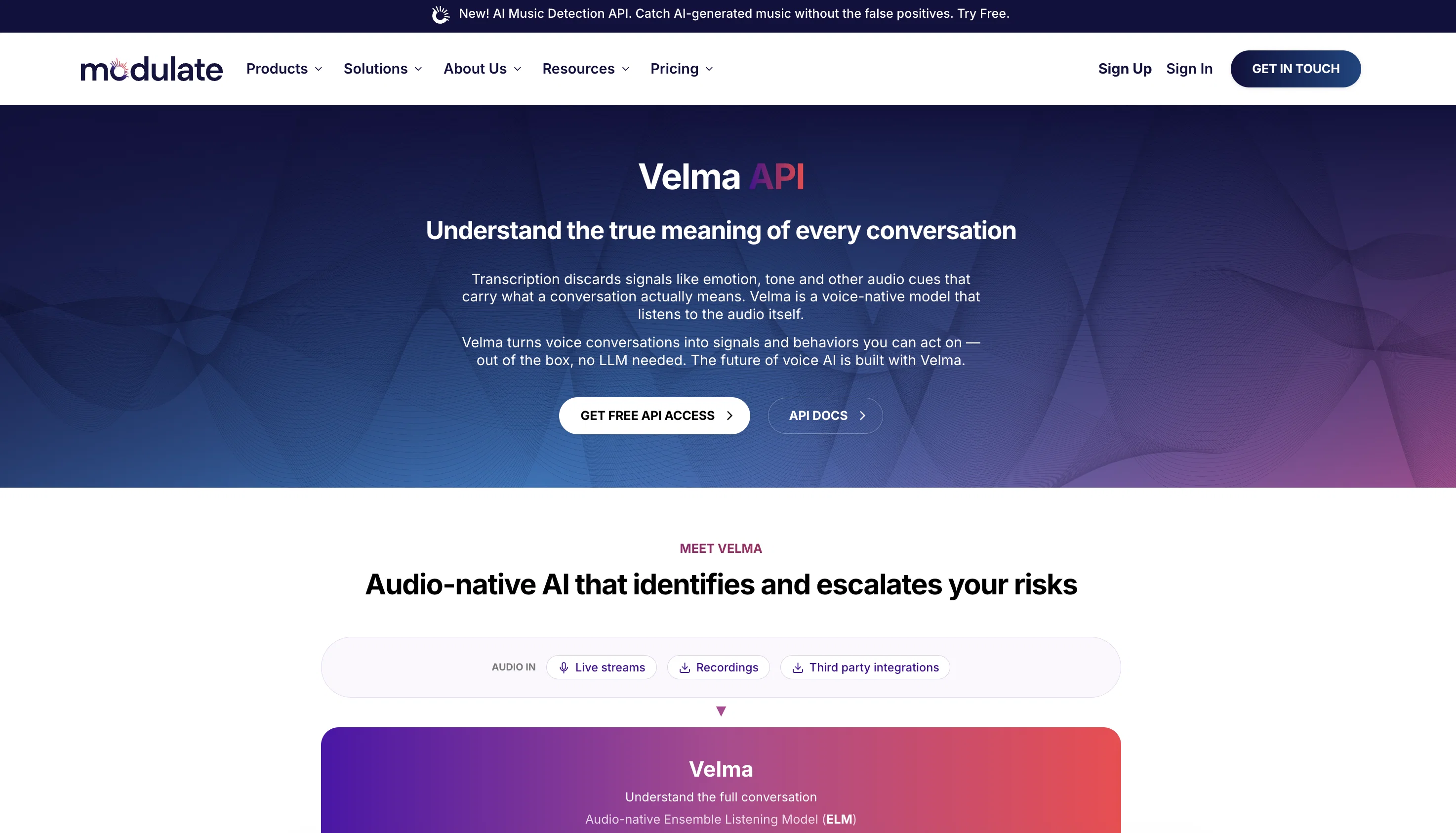
Velma Voice Analytics API, a product from Modulate, is designed to analyze and interpret emotion, tone, and intent from voice conversations. Rather than focusing solely on transcription, Velma is an audio-native model, listening to the voice conversation directly and analyzing the acoustic signals that carry the conversation's meaning. This tool turns voice conversations into actionable signals and behaviors. It can process both live streams and recordings, integrating with third-party tools. One of Velma's unique features is its ability to analyze behaviors and escalate risks. A typical application includes alerting to potential risks like fraud or impersonation scams, with each alert including data on the type of threat and confidence level. The tool can recognize a range of emotions expressed by speakers - from frustrated and anxious to calm and confident. Through its Audio-native Ensemble Listening Model (ELM), Velma is capable of understanding the nuances in conversation typically lost in other models that rely heavily on pure word transcription. Velma aims to capture more than just words; it seeks to understand the full spectrum of a conversation, even to the point of detecting deepfake voices or spoofed calls. The tool offers comprehensive conversation summaries, listing detected key behaviors, speaker topics, speaker emotions, and sentiment analysis among others. This makes it a suitable tool for various use cases like fraud prevention, policy enforcement, voice agent understanding, and user safety among others across industries like customer experience centers, IT & helpdesk, gaming & social, and financial services. With these detailed insights, Velma can contribute to better decision making and problem-solving in these settings. Help other people by letting them know if this AI was useful. Add your own prompts and outputs to help others understand how to use this AI.
When considering Velma API by Modulate for integration into your organizational workflow, we recommend deploying a structured score card across three critical operational pillars: Security & Compliance, Integration Friction, and long-term Price Scalability. Rather than looking only at basic feature lists, modern procurement teams must assess how a software platform behaves under high load and how well it fits into the team's data security guidelines.
Depending on your operating region and field, ensure that Velma API by Modulate supports standard security layers such as SOC 2 Type II certifications, GDPR compliance, or HIPAA-compliant database encryption. If the tool connects directly to client database tables or handles user passwords, verify that they implement multi-factor authentication (MFA), single sign-on (SSO) integrations, and end-to-end data encryption in transit and at rest.
Siloed data is the primary cause of operational friction. Evaluate if Velma API by Modulate has native connectors for your current project trackers, messaging hubs, and customer communication channels. For custom developer requirements, check if they provide a fully documented REST API with reasonable rate limits, comprehensive Webhooks support, and robust SDK packages in your language. A flexible API layer saves hundreds of hours of manual copy-paste overhead.
SaaS pricing packages are often deceptively simple. When reviewing Velma API by Modulate's billing structure, map out your team's projected expansion over the next 12 to 24 months. Determine how costs scale as your customer database increases or as you add team members. Factor in setup costs, mandatory support plan upgrades, API access fees, and storage overage rates to understand the true cost before committing to a contract.
By combining verified user reviews from our directory with internal workflow pilot tests, your procurement team can make an informed decision that drives productivity without creating capital waste.
Overall rating
Based on 6 reviews
Very interesting
Béatrice Duval
This tool i found is super cool, I created 5 books from this tool to sell them online, which gives me great profit. I am creating more valuable books to spread knowledge, and earn some bucks as well 🤑.
Bilal Ashraf
State of the Art
Dmitry G.
Not at all accurate…. The only thing similar between original and generated images were the clothes and accessories… face was absolutely new and unconnected.
Shvetank Sharma
It did not transcribe the whole audio file as it should and theres pieces missing in the transcript it needs to isolate background sound and only focus on the audio thats being spoken
Christo Simons
Started out good and has real potential, but the owners got greedy. You used to be charged 1 credit for each generation and got 20 free credits a day. Now you get 30 credits, but (for example Flux pro ultra) costs 9 credits and some change, meaning you get just 3 credits a day in reality. And when a run fails you are still charged so if you click a fourth time and it fails, they subtract and put you into credit debt (negative credits). Greed... the downfall of so many AI art websites. You are better off just buying a miniPC with good memory and good video card and downloading Flux to your computer and running it locally. The pricing? Let's do the math. $2 for 200 credits, but a Flux ultra run will cost you 9.97 credits. So for $2 you get actually 20 runs, and that is what you used to get each day for free. Totally not worth your money, especially when they charge you for failed runs too and the fact that on the average, it will take you 5 or 6 runs to get a decent picture that doesn't have deformed hands or other defects or deviations from what you are looking for. Better to download stable diffusion and run flux on it or uses any of the other local ways to run AI art if you can.
Mic
Starting Price
Free plan available
Free tier available with optional paid upgrades.