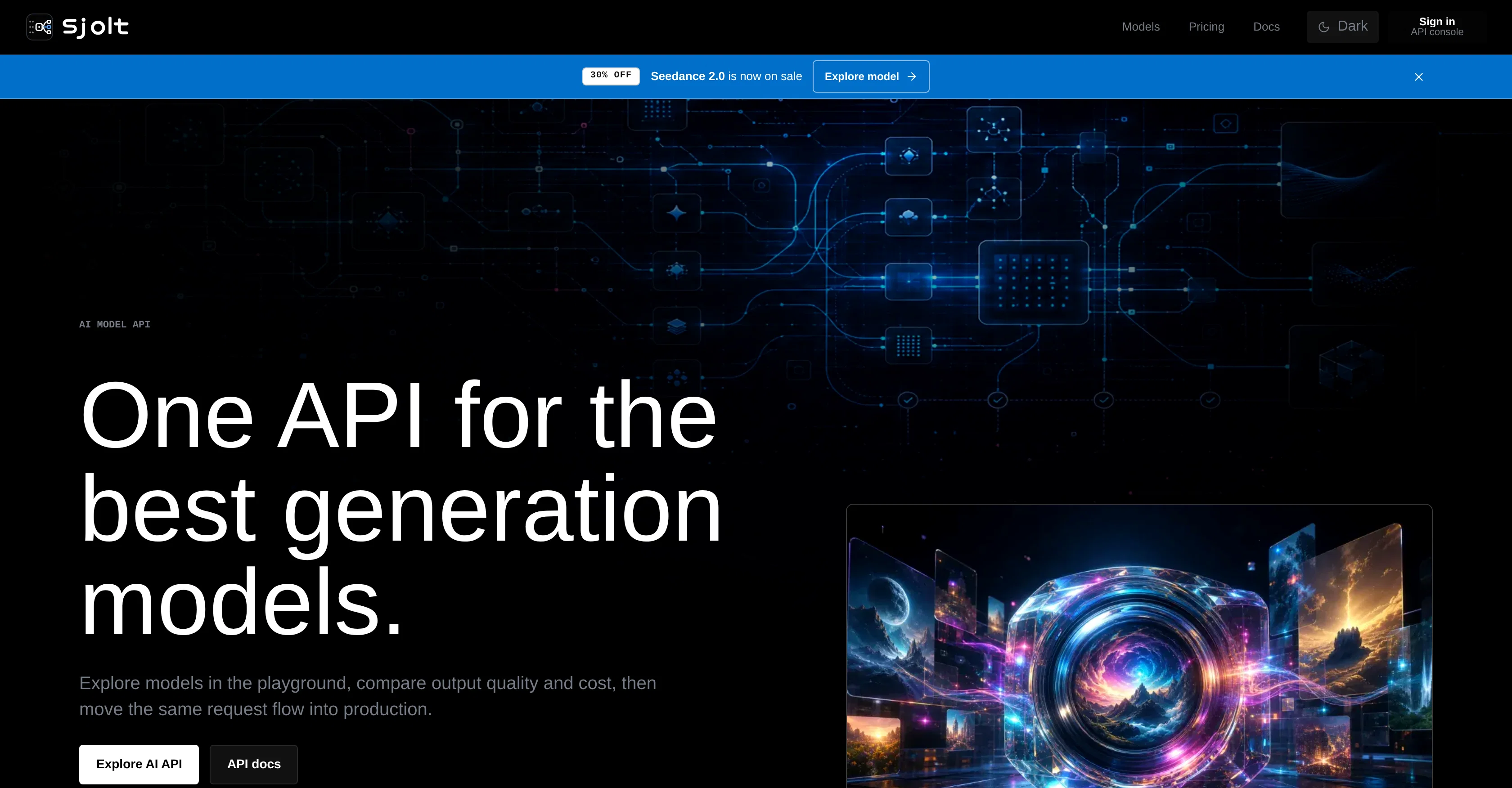
Sjolt is an AI model API platform that provides access to an array of generation models mainly for images and videos. It simplifies the exploration process by offering a playground environment where users can compare the output quality and cost of different models, then effectively implement the selected model into their production environment.
The intuitive platform allows for model choice to transition seamlessly to production calls without the need to switch tools. A selection of generation, editing, and multimodal workflows are available to choose based on specific tasks.
Integration with the sjolt API is user-friendly, with API-ready inputs including prompt, ratio, duration, and source assets. Billing is usage-based across the selected models.
Users can inspect model output samples before committing to a model, ensuring proper fit for the intended purpose. Some of the models mentioned include 'Seedance 2.0', a multimodal video generation model by ByteDance, 'GPT Image 2', an image generation model by OpenAI, and the 'Kling 3.0', a video generation model by Kuaishou.
The sjolt platform facilitates async status tracking and one-request pattern across supported models. Additionally, Sjolt provides clear operational notes and API examples for a smooth integration process.
The API platform is designed to support product teams, developers, and creators in their AI modeling needs.
Help other people by letting them know if this AI was useful.
Add your own prompts and outputs to help others understand how to use this AI.
Screenshot gallery
Pros & Cons
Pros
+Array of generation models
+Playground environment
+Compare output quality
+Compare cost of models
+Seamless transition to production
+User-friendly API integration
+Usage-based billing
+Inspect output before commitment
+Async status tracking
+Operational notes provided
+Clear API examples
+Supports product teams, developers, creators
+One API for multiple models
+Ready-to-use API inputs
+Supports Seedance 2.0, GPT Image 2, Kling 3.0
+Image and video generation
+Editing and multimodal workflows
+One-request pattern support
+Model-specific pricing visible
+Browser model catalog
+Test models with API-ready inputs
+Track usage and cost
+Supports long-running async jobs
+Quality, cost, status tracking comparison
+Prompt, ratio, duration, source assets inputs
+Model output inspection
+One balance covers model usage
+Billing views for finance review
+Model coverage visible before integration
+Task, inputs, outputs, status tracking catalog
+Same request flow across models
+Operational notes for integration
+Test model on playground
+API examples cover multiple languages
+Async job status updates
+Supports Image-to-video workflows
+Supports image editing workflows
+No tool switching for production
+Ability to reuse API example
+Explore model in playground
+Same object from playground to production
+Supports cinematic visuals generation
Cons
−Limited to image/video generation
−Usage-based billing fluctuations
−Dependent on model availability
−Difficult to estimate costs
−Async requests could delay
−Requires constant status tracking
−Limited predefined workflows
−Model selection could be challenging
−Inspection limited to model samples
A Professional Framework to Evaluate SJolt
When considering SJolt for integration into your organizational workflow, we recommend deploying a structured score card across three critical operational pillars: Security & Compliance, Integration Friction, and long-term Price Scalability. Rather than looking only at basic feature lists, modern procurement teams must assess how a software platform behaves under high load and how well it fits into the team's data security guidelines.
1. Security and Database Compliance
Depending on your operating region and field, ensure that SJolt supports standard security layers such as SOC 2 Type II certifications, GDPR compliance, or HIPAA-compliant database encryption. If the tool connects directly to client database tables or handles user passwords, verify that they implement multi-factor authentication (MFA), single sign-on (SSO) integrations, and end-to-end data encryption in transit and at rest.
2. API Coverage and Custom Integrations
Siloed data is the primary cause of operational friction. Evaluate if SJolt has native connectors for your current project trackers, messaging hubs, and customer communication channels. For custom developer requirements, check if they provide a fully documented REST API with reasonable rate limits, comprehensive Webhooks support, and robust SDK packages in your language. A flexible API layer saves hundreds of hours of manual copy-paste overhead.
3. Total Cost of Ownership (TCO)
SaaS pricing packages are often deceptively simple. When reviewing SJolt's billing structure, map out your team's projected expansion over the next 12 to 24 months. Determine how costs scale as your customer database increases or as you add team members. Factor in setup costs, mandatory support plan upgrades, API access fees, and storage overage rates to understand the true cost before committing to a contract.
By combining verified user reviews from our directory with internal workflow pilot tests, your procurement team can make an informed decision that drives productivity without creating capital waste.
Features of SJolt
API
AI Model API
Image Generation
Video Generation
Model Selection
Multimodal Workflows
From $0.02
SaaS1to10 verified reviews for SJolt
Overall rating
★★★★★5.0
Based on 1 reviews
★★★★★5.02 months ago
“Review”
I'm giving it two stars because it does do an ok job on videos but I would NOT recommend this. The "free trial" gives you 80 credits. It's not even enough to make a 60 second video so you can't really "trial" anything. I then spent $35 to make a 60 second video and I did two edits to it and I only have 451 credits left for the month. Until the costs come down, this is not feasible.
Pam L
Pricing
Starting Price
From $10.00/user/month
Pricing may vary based on team size and features selected.