5.02 months ago
“Review”
ATS optimisation with the help of AI insights is very helpful.
Ruma Bill

Amplify confidence in underwriting decisions with AI
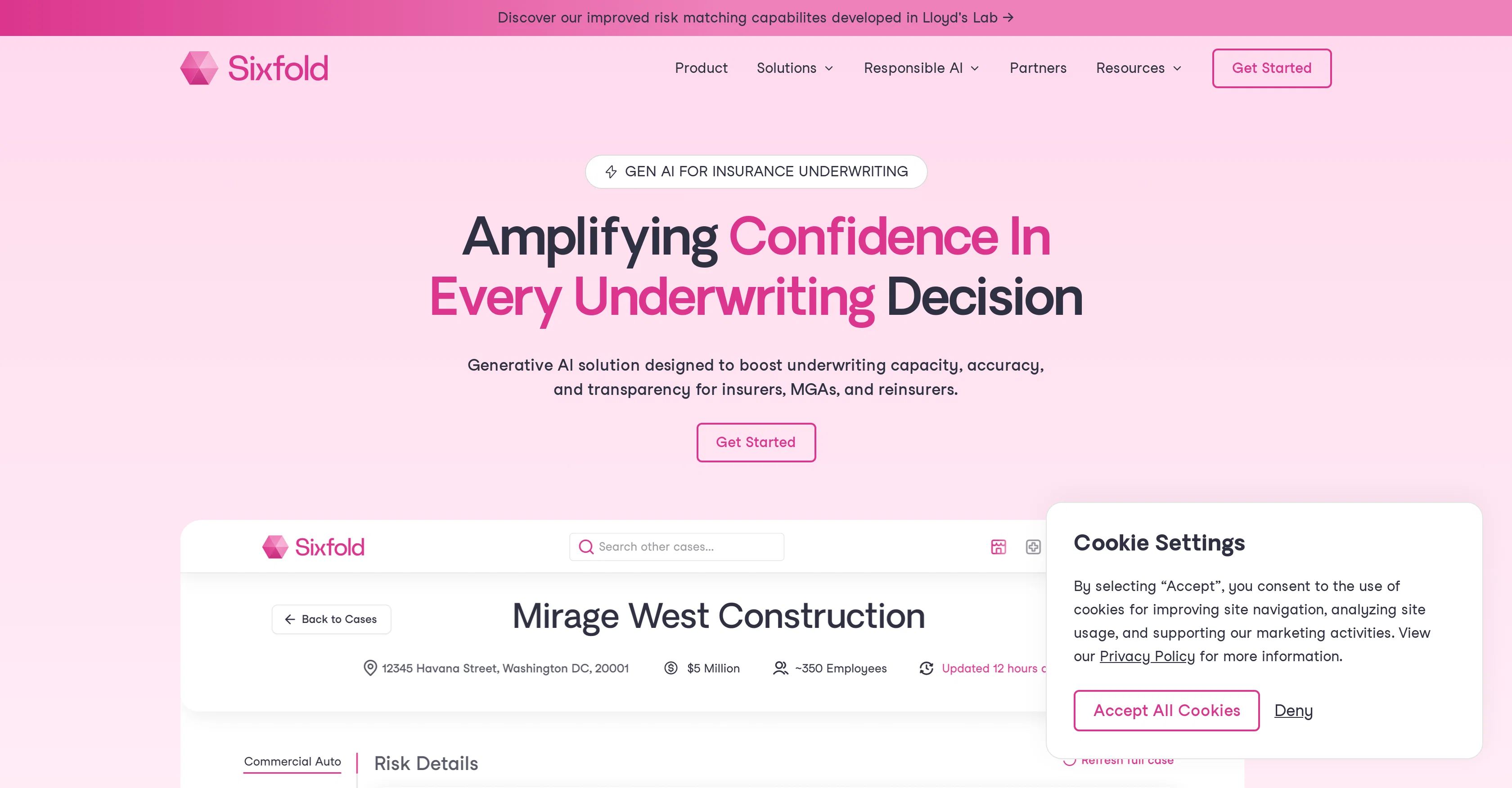
Sixfold provides a Generative AI solution designed for insurance underwriters. The tool ingests underwriting manuals, and highlights positive, negative, and disqualifying risk factors. It also gathers risk data from underwriting submissions, supporting documents, and third-party sources. Sixfold then generates semantic matches, summaries, and underwriting suggestions that are tailored to the users' unique risk appetite. The tool aims to boost underwriting capacity, transparency, and enhance the accuracy in decision making. It provides complete transparency around underwriting decisions, which might be appreciated by compliance teams. It can automate workflows by identifying patterns from various sources and uses generative AI to summarize risks in an underwriter's format. Sixfold also offers full traceability of all underwriting decisions, no mixing of data, and provides enterprise-grade security. The tool is designed to integrate with existing technology, avoiding the need to overhaul legacy systems. Help other people by letting them know if this AI was useful. Add your own prompts and outputs to help others understand how to use this AI.
When considering Sixfold for integration into your organizational workflow, we recommend deploying a structured score card across three critical operational pillars: Security & Compliance, Integration Friction, and long-term Price Scalability. Rather than looking only at basic feature lists, modern procurement teams must assess how a software platform behaves under high load and how well it fits into the team's data security guidelines.
Depending on your operating region and field, ensure that Sixfold supports standard security layers such as SOC 2 Type II certifications, GDPR compliance, or HIPAA-compliant database encryption. If the tool connects directly to client database tables or handles user passwords, verify that they implement multi-factor authentication (MFA), single sign-on (SSO) integrations, and end-to-end data encryption in transit and at rest.
Siloed data is the primary cause of operational friction. Evaluate if Sixfold has native connectors for your current project trackers, messaging hubs, and customer communication channels. For custom developer requirements, check if they provide a fully documented REST API with reasonable rate limits, comprehensive Webhooks support, and robust SDK packages in your language. A flexible API layer saves hundreds of hours of manual copy-paste overhead.
SaaS pricing packages are often deceptively simple. When reviewing Sixfold's billing structure, map out your team's projected expansion over the next 12 to 24 months. Determine how costs scale as your customer database increases or as you add team members. Factor in setup costs, mandatory support plan upgrades, API access fees, and storage overage rates to understand the true cost before committing to a contract.
By combining verified user reviews from our directory with internal workflow pilot tests, your procurement team can make an informed decision that drives productivity without creating capital waste.
Overall rating
Based on 4 reviews
ATS optimisation with the help of AI insights is very helpful.
Ruma Bill
5 Star Customer Service ready to assist you 24/7. Help us stay the #1 free AI job recruitment tool in the nation by giving us a happy review :) Do it for the mission: good AI for ALL
WorkUp
@Insight7 helps us with customer, employee and stakeholder focus group interview analysis. Has a fantastic UX and saves us hours doing manual analysis!
Odun
Really interesting approach with @SquareGen. Quick observation: the product is framed as LLM credit scoring, but lenders don’t buy models — they buy lower default rates. If a lender with a $100M book drops defaults by even 1%, that’s ~$1M saved annually. Positioning around credit loss reduction could massively change the commercial narrative. Happy to share a few thoughts.
Paul
Starting Price
Contact vendor for pricing
Pricing may vary based on team size and features selected.