5.01 months ago
“Review”
It is genius! And seems to be free. I can't believe!
Youssef Moustafa

AI-powered research tool for scientific literature
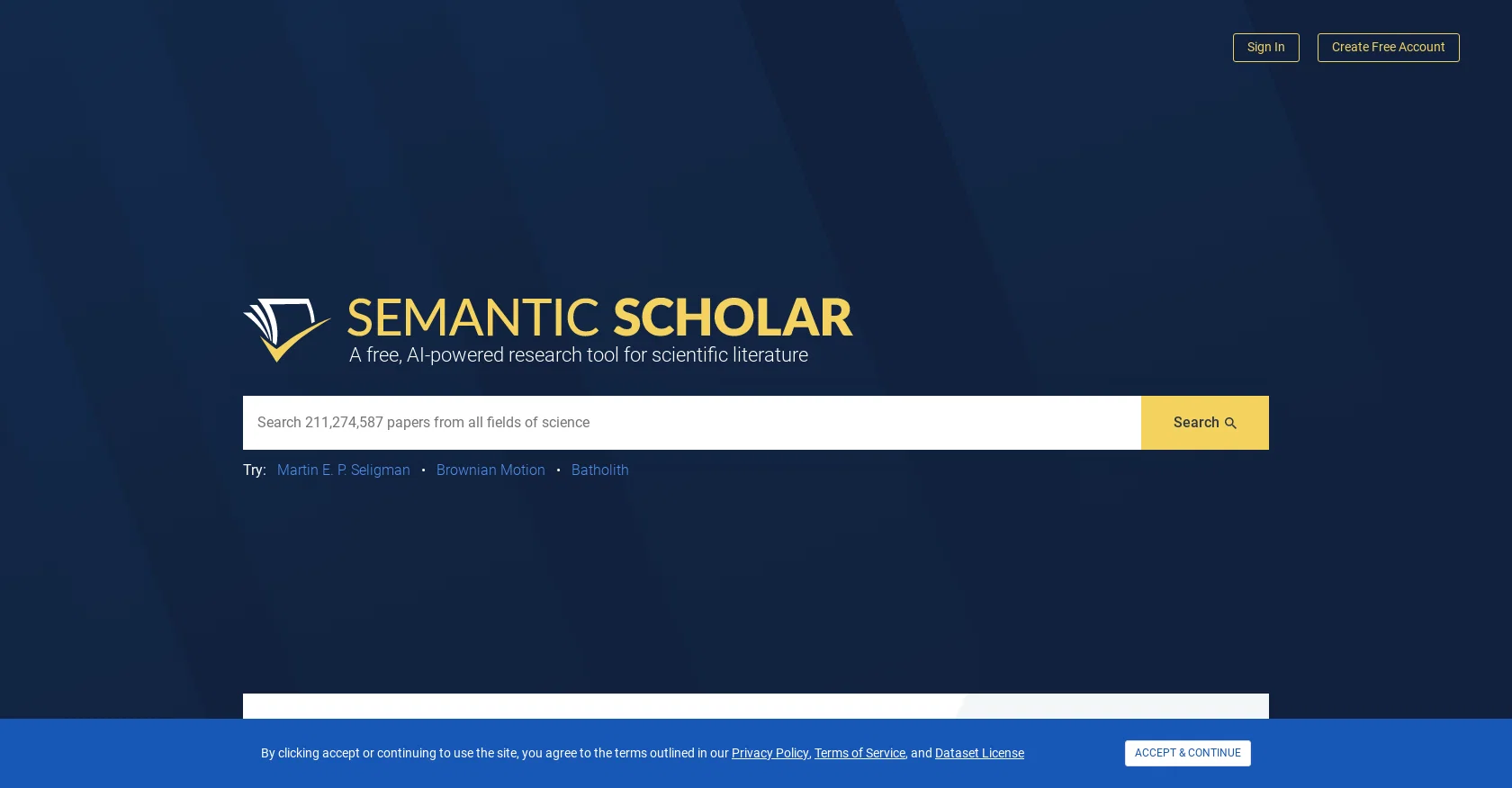
Semantic Scholar is a free AI-powered research tool that aggregates scientific literature from various fields of science, including nanotechnology and moral reasoning, and uses AI and engineering to understand the semantics of the research to help scholars discover relevant publications. The platform currently archives over 211 million papers. Also, the tool has a beta program, Semantic Reader, that provides an augmented reading experience to help increase accessibility and richness to scientific literature. Besides, Semantic Scholar has a newly improved API for developers, which allows searching for papers on the platform, better documentation, and improved stability. Semantic Scholar was developed by the Allen Institute for AI, which focuses on creating efficiency in AI research to decrease carbon footprint and increase inclusivity. Researchers who use Semantic Scholar can sign up and stay connected to receive alerts about relevant papers, as well as receive updates about new features and releases. The platform is open to publishers who want to contribute their research, and a team of expert researchers composes the Semantic Scholar team. The platform also offers a detailed FAQ section and tutorials to help users understand the tool's full range of capabilities. Overall, Semantic Scholar is a highly useful research tool for scholars, allowing them to discover relevant scientific publications with the power of AI. Help other people by letting them know if this AI was useful. Add your own prompts and outputs to help others understand how to use this AI.
When considering Semantic Scholar for integration into your organizational workflow, we recommend deploying a structured score card across three critical operational pillars: Security & Compliance, Integration Friction, and long-term Price Scalability. Rather than looking only at basic feature lists, modern procurement teams must assess how a software platform behaves under high load and how well it fits into the team's data security guidelines.
Depending on your operating region and field, ensure that Semantic Scholar supports standard security layers such as SOC 2 Type II certifications, GDPR compliance, or HIPAA-compliant database encryption. If the tool connects directly to client database tables or handles user passwords, verify that they implement multi-factor authentication (MFA), single sign-on (SSO) integrations, and end-to-end data encryption in transit and at rest.
Siloed data is the primary cause of operational friction. Evaluate if Semantic Scholar has native connectors for your current project trackers, messaging hubs, and customer communication channels. For custom developer requirements, check if they provide a fully documented REST API with reasonable rate limits, comprehensive Webhooks support, and robust SDK packages in your language. A flexible API layer saves hundreds of hours of manual copy-paste overhead.
SaaS pricing packages are often deceptively simple. When reviewing Semantic Scholar's billing structure, map out your team's projected expansion over the next 12 to 24 months. Determine how costs scale as your customer database increases or as you add team members. Factor in setup costs, mandatory support plan upgrades, API access fees, and storage overage rates to understand the true cost before committing to a contract.
By combining verified user reviews from our directory with internal workflow pilot tests, your procurement team can make an informed decision that drives productivity without creating capital waste.
Overall rating
Based on 22 reviews
It is genius! And seems to be free. I can't believe!
Youssef Moustafa
That looks really good
Sebastian Alonso Guerilla
Nice interface, but no good at PDF answers, especially tables data.
hifive szu
I tried NovelGPT a template in @Agentgpt and it did an excellent job writing the first two episodes of my novel complete with character descriptions, setting,plot points and well I think you get the point. Great tool can't wait to see it out of beta.
Kelli Crose
I tried using it but the website has too many bugs.
João Neiva
Great idea, but does not find what you are looking for-about the same as Google Scholar
Andy
An amazing app, I love the share feature and the comment section summaries
Silvia Cho
O GPT faz uma análise melhor e mais personalizada.
Vinicius Vilela
I want Research Theoretical Framework
nathaniel derder
It seems to be working fine right now. Maybe try again and double check if you’re using the book’s original or most recognized title. That might make a difference.
Alexandru Bostina
Tried using it to get answers for a few questions, but what really impressed me was how many sources it pulled in. Didnt expect that, but it actually turned out to be super useful. Nice tool :)
Marley Blenkinsop
after playing around with it for a bit, i am now aware of how much i need this. i can already feel the hours of sleep coming back to me <3
Bru no no no
As the service was in beta-testing stage, I created there a dozen of AI-generated courses for free. I wanted to use them. Those courses remained in my account as they started subscription tiers. But recently I have found out that they were deleted. The support didn't answer to my e-mail at all.
Oldfag TV
Really amazing! Makes learning content and engaging with things so much easier!
Jamie McDonald
Alternative for fast academic writing
Ivan Taslim
I'm still testing the tool yet it looks very promising. I tested it with a 5.5k words Academic text that I had previously red. I tested the Key points feature, it does work!
Ivana González
I’ve been using it for a month now and I have decided to keep it for a year. There definitely are some kinks they can still work out like file management, but it’s very good at it’s core function: it generally does a good job answering questions and most times identifies PDFs automatically and correctly. The browser plugin works great, and it’s very nice that @Papers allows you to add your university’s library API so you can automatically download PDFs that are accessible through your institution (sometimes it refuses to download some @Papers, so you just have to downlow it yourself and manually add it). The iPad and Android apps are serviceable. Every once in a while it will mess up the PDF identification, especially with @Papers from either very old sources or online-only journals. Things they must work on: * A much better system to annotate PDFs (the post-it type notes are cumbersome). * Introduce a notepad attached to each PDF or some way to easily link and save the AI’s output to the PDF. Currently, you have to add a little post it note and then paste the text there. * Keep the AI answers available after closing the documents. If you close the document by mistake or have several open and wish to close some, the ai conversation will be reset. * I REALLY wish that you could get citations and links to where the info was from extracted from PDFs. Currently, I have found Coral.ai does a much better job of showing you where the info came from and it even highlights it for you. Give it a try, their 30-day no credit card needed trial allowed me to truly test it, and now I’m a yearly subscriber looking forward for new additions and releases.
JB
Not particularly useful and expensive at the same time. Don’t waste your time or money.
Yakir Levin
Think its a fab tool but why wont it allow you to save your workflows?
Azmat Yusaf
Such an impressive platform for all of us who are looking for more efficient ways to do the investigation. @OpenRead has the potential to solve our problems.
Zhuohang Tong
I've tried to find the exact articles via WoS, Google, or Scopus. Despite using a very advised and complicated search query, it was just a waste of time. Perplexity didn't help either. The Jenni AI, which may add useful links when generating text, finds nothing but trash. SciScape gave exactly what I needed from the first query! A couple of fresh relative articles with very exact topics!
Elijah
easy to pick up and you get a few free file imports. it gives you results pretty fast, unfortunately i can't find a way to get back to these, they're locked behind the paid service.
Ron Jayson
Starting Price
Free plan available
Free tier available with optional paid upgrades.