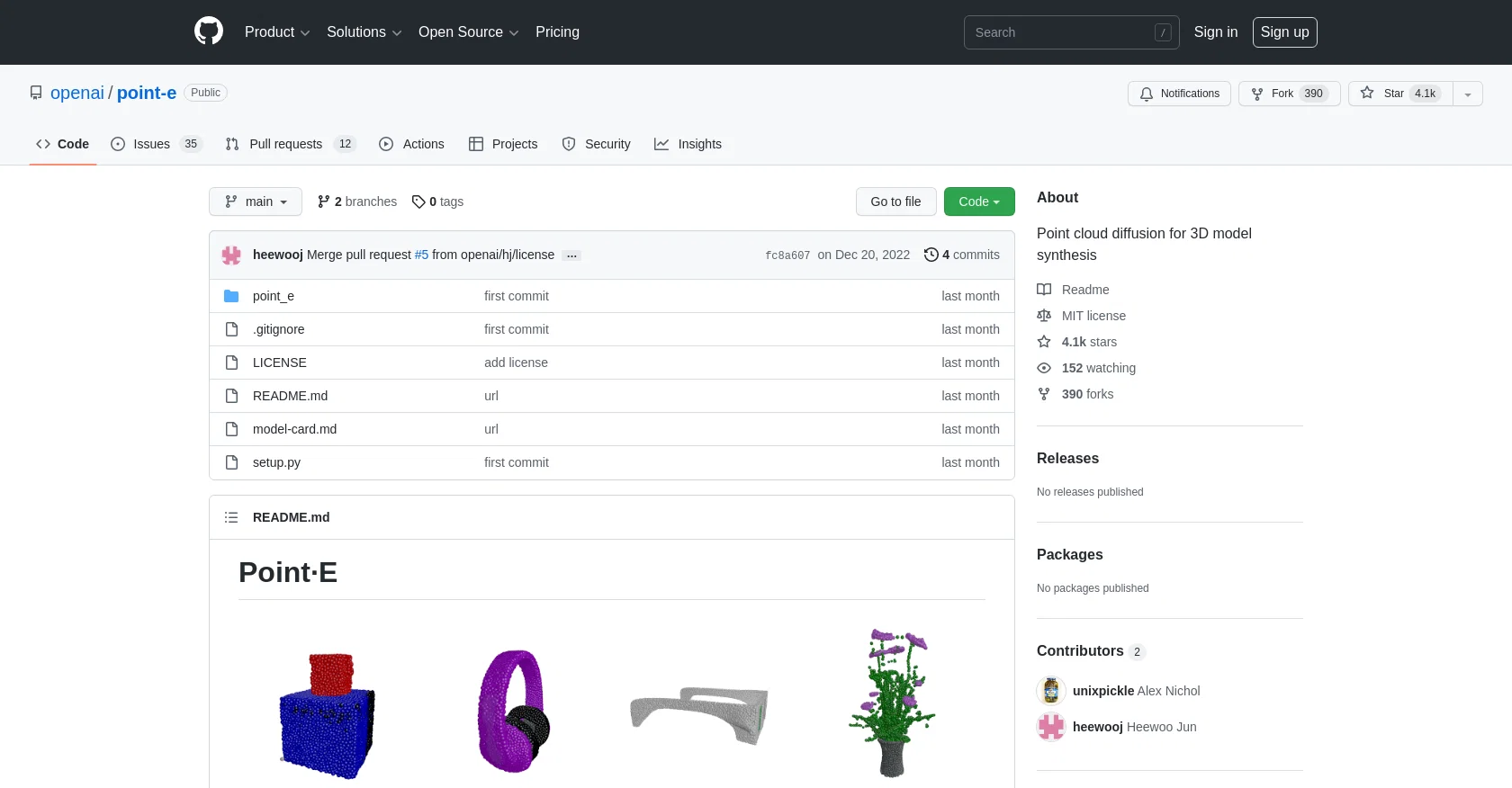
OpenAI's Point-E is an AI tool for synthesizing 3D models from point clouds. It uses a diffusion algorithm to transform point clouds into 3D models and is designed to create detailed, realistic models.
Point-E is available as an open source project on GitHub and is released under the MIT license. It uses a variety of tools and packages, such as GitHub Actions and Codespaces, to automate workflows and create instant development environments.
It also features a variety of features, such as code review and issues tracking, to help ensure high quality and efficient code. Point-E also includes a model-card for describing the model used for synthesis and a setup.py for installing the package.
To use Point-E, users can clone the repository via HTTPS, GitHub CLI or SVN, and launch GitHub Desktop, Xcode or Visual Studio Code to get started. It can then be used to generate 3D models from complex point clouds, with the output being highly realistic and detailed.
Help other people by letting them know if this AI was useful.
Add your own prompts and outputs to help others understand how to use this AI.
Screenshot gallery
Pros & Cons
Pros
+Open source
+MIT license
+GitHub Actions
+Automated workflows
+Code review
+Issue tracking
+Instant development environments
+Highly detailed models
+Realistic 3D output
+Model-card for descriptive synthesis
+Setup.py for package installation
+Multiple repository cloning methods
+Detailed README.md
+Includes examples
+Diffusion algorithm
+Python based
+Jupyter notebook compatible
+Issue and pull request tracking
+Active community with contributors
+Integrated with GitHub desktop
+Supports Xcode and Visual Studio Code
+Detailed model metadata
+Codebase version control
+Downloadable 3D examples
+High project popularity (4.1k stars)
+Active community (389 forks)
Cons
−Diffusion algorithm may be complex
−Detailed environment setup required
−Some features limited in quality
−Requires knowledge of GitHub
−May over-complicate simpler tasks
−Depends on external packages
−Realism of models may vary
−No clear update schedule
−Reliant on specific dev environments
−Only Python and Jupyter supported
A Professional Framework to Evaluate Point·E
When considering Point·E for integration into your organizational workflow, we recommend deploying a structured score card across three critical operational pillars: Security & Compliance, Integration Friction, and long-term Price Scalability. Rather than looking only at basic feature lists, modern procurement teams must assess how a software platform behaves under high load and how well it fits into the team's data security guidelines.
1. Security and Database Compliance
Depending on your operating region and field, ensure that Point·E supports standard security layers such as SOC 2 Type II certifications, GDPR compliance, or HIPAA-compliant database encryption. If the tool connects directly to client database tables or handles user passwords, verify that they implement multi-factor authentication (MFA), single sign-on (SSO) integrations, and end-to-end data encryption in transit and at rest.
2. API Coverage and Custom Integrations
Siloed data is the primary cause of operational friction. Evaluate if Point·E has native connectors for your current project trackers, messaging hubs, and customer communication channels. For custom developer requirements, check if they provide a fully documented REST API with reasonable rate limits, comprehensive Webhooks support, and robust SDK packages in your language. A flexible API layer saves hundreds of hours of manual copy-paste overhead.
3. Total Cost of Ownership (TCO)
SaaS pricing packages are often deceptively simple. When reviewing Point·E's billing structure, map out your team's projected expansion over the next 12 to 24 months. Determine how costs scale as your customer database increases or as you add team members. Factor in setup costs, mandatory support plan upgrades, API access fees, and storage overage rates to understand the true cost before committing to a contract.
By combining verified user reviews from our directory with internal workflow pilot tests, your procurement team can make an informed decision that drives productivity without creating capital waste.
Features of Point·E
Point Clouds
3D Reconstruction
3D Modeling
Computer Vision
Lidar Data Processing
Photogrammetry
SaaS1to10 verified reviews for Point·E
Overall rating
★★★★★5.0
Based on 18 reviews
★★★★★5.02 months ago
“Review”
It created animals with more than 4 legs and multiple animals when I asked for one. Sometimes you have to run it a few times with the same prompt to get something usable, but even then it probably won't be what you are thinking in your head. That being said, I think it is a good start, and for kids that just want to color something for free, it's cool to play with. It is definitely not the same quality as even the lower-end HuggingFace Stable Diffusion projects.
B C
★★★★★5.02 months ago
“Review”
6 seconds of video generation per month for free accounts
Luis Antonio Lanetti
★★★★★5.02 months ago
“Review”
Selamat siang saya akan membagikan tutorial gimana caranya mengedit video di aplikasi capcut
Rhyben Rinto
★★★★★5.02 months ago
“Review”
paid and stuff and not that good
Max Adventures
★★★★★5.02 months ago
“Review”
I've tried to find the exact articles via WoS, Google, or Scopus. Despite using a very advised and complicated search query, it was just a waste of time. Perplexity didn't help either. The Jenni AI, which may add useful links when generating text, finds nothing but trash. SciScape gave exactly what I needed from the first query! A couple of fresh relative articles with very exact topics!
Elijah
★★★★★5.02 months ago
“Review”
Such a great place to start out!
Helli Lang
★★★★★5.02 months ago
“Review”
Free Start with a Free Experience $0 /mo
Vitus Bering
★★★★★5.02 months ago
“Review”
Really amazing! Makes learning content and engaging with things so much easier!
Jamie McDonald
★★★★★5.02 months ago
“Review”
As the service was in beta-testing stage, I created there a dozen of AI-generated courses for free. I wanted to use them. Those courses remained in my account as they started subscription tiers. But recently I have found out that they were deleted. The support didn't answer to my e-mail at all.
Oldfag TV
★★★★★5.02 months ago
“Review”
It's too complicated for a beginner
Giti Mortazavi
★★★★★5.02 months ago
“Review”
Diffusion pulls out extremely good images from simple prompts. Renders were a little slow on higher quality, but totally worth it for the results. The controls feel clear enough and the outputs look legit. Good one here!
Harsh Nether
★★★★★5.02 months ago
“Review”
O GPT faz uma análise melhor e mais personalizada.
Vinicius Vilela
★★★★★5.02 months ago
“Review”
This one is great for logo and poster concepts. The vector-style output looks clean, and it handled a few pixel-art prompts better than expected. I’d still like tighter controls for fonts and style consistency, but it’s a strong tool overall.
Oleg John
★★★★★5.02 months ago
“Review”
very terrible
熊恒
★★★★★5.02 months ago
“Review”
One of the most stylish Image Generator out there. And the Remix function (sort of inpainting) works wonderfully
Christopher Valdes
★★★★★5.02 months ago
“Review”
the master summoned genie and watched a 3d form rise from simple words. the first shape came swiftly, though some surfaces needed patience and a clearer hand. still, for exploring ideas before the heavier craft begins, this tool carries much promise.
Jan Tang
★★★★★5.02 months ago
“Review”
the master tested the power of @Tripo3d and found it worthy. with only words as his weapon, forms took shape in mere moments. though some shapes needed guidance, the path was swift and free of tolls. for those who seek to build without burden, this tool offers much to learn from.
Jan Tang
★★★★★5.02 months ago
“Review”
A whole new way of learning how to code
Francisco Silverio
Pricing
Starting Price
Contact vendor for pricing
Pricing may vary based on team size and features selected.