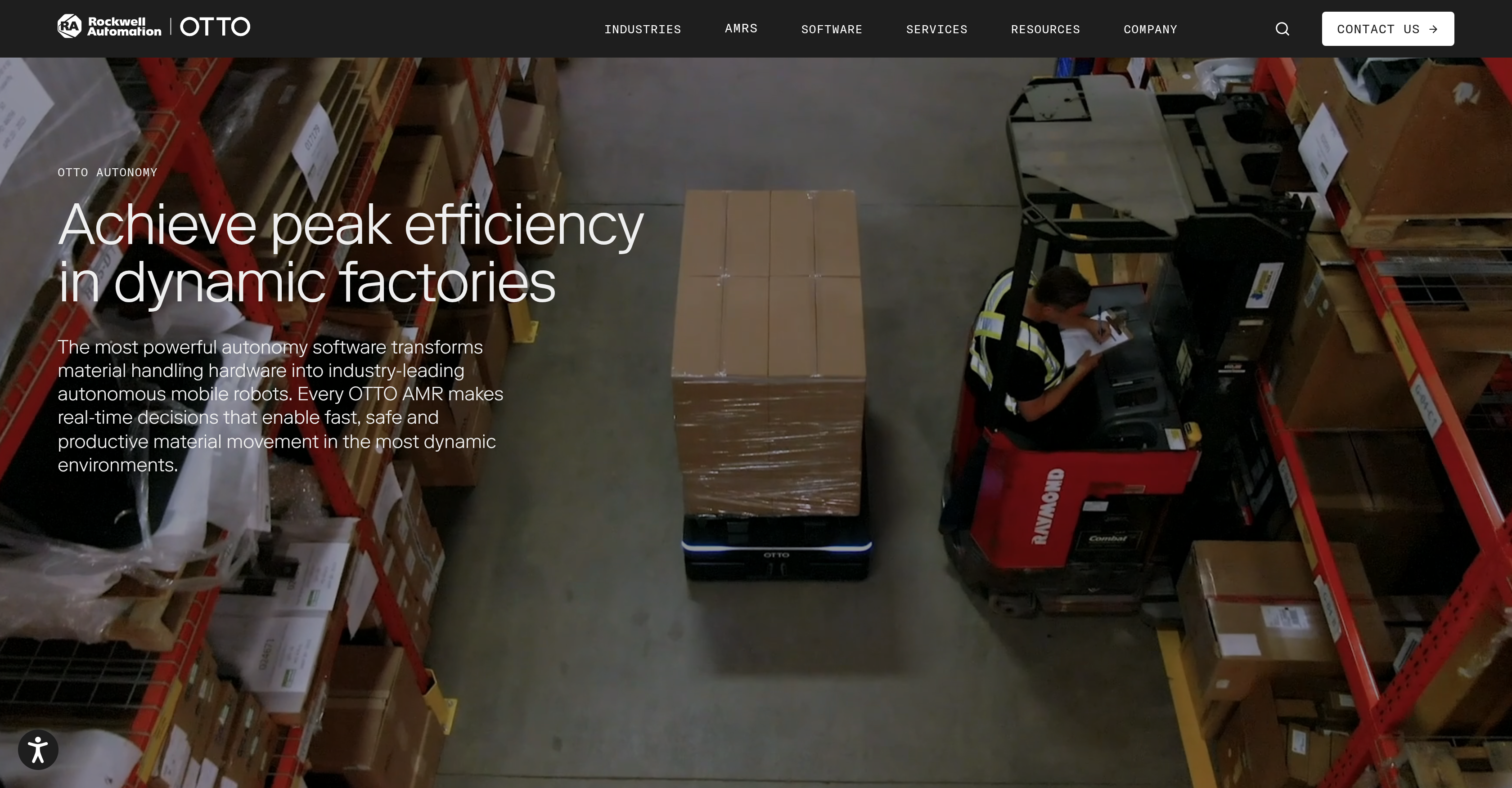
OTTO Autonomy, developed by Rockwell Automation, is an advanced autonomous driving software designed to power Autonomous Mobile Robots (AMRs) for optimal performance and safety in industrial settings, particularly in dynamic factories.
This intelligent software enables the AMRs to make real-time decisions, enhancing their ability to move materials quickly, safely, and productively in highly dynamic environments.
The software has several notable capabilities. It integrates with LiDAR and 3D cameras to detect surrounding objects and efficiently navigate spaces, aided further by a suite of specialized sensors and a computing component that uses sensor fusion for efficient routing and obstacle avoidance.
The AMRs powered by OTTO Autonomy also have features for localization, being able 'to know' their location in real-time, even in ever-changing environments, which aids in their faster navigation.
Path generation, obstacle detection and avoidance, adaptive fieldset technology, and the OTTO Fleet Manager a platform that works in synchrony with OTTO Autonomy to keep an AMR fleet moving optimally are part of its feature set.
Thus, the software significantly enhances the efficiency of material movement in industrial settings.
Help other people by letting them know if this AI was useful.
Add your own prompts and outputs to help others understand how to use this AI.
Screenshot gallery
Pros & Cons
Pros
+Advanced autonomous driving software
+Optimized for industrial settings
+Real-time decision making
+Material movement efficiency
+Operational in dynamic factories
+LiDAR integration
+3D camera integration
+Specialized sensor suite
+Sensor fusion strategy
+Obstacle detection and avoidance
+Real-time localization feature
+Fast navigation in changeable environments
+Optimal path generation
+Adaptive fieldset technology
+Integrated fleet management
+Detects surrounding objects
+Efficient operation in complex spaces
+Senses skewed pallet placements
+Maintains stability during transport
+Mapping updates in real-time
+Creates predictable paths
+Dynamic re-planning
+Keeps speed around obstacles
+Senses objects above and below LiDAR plane
+Balances speed and safety
+Real-time fleet performance optimization
+User-friendly platform
+Performs in highly dynamic environments
+Individual robot performance optimization
+Safety in material handling
+Precise decision making
+Detects overhanging objects
+Leeverages set traffic rules
+Improved visibility in direction of travel
+Faster navigation on future visits
+Determines preferred paths
+Avoids triggering safety stops
+Retains productivity around obstacles
+Maneuvers around people
+Maneuvers around turns
+Peak efficiency in dynamic factories
+Best-in-class average speeds
+Fast, safe, productive material movement
+Same platform fleet management
+Localization in ever-changing environments
+Partnership with Rockwell Automation
+Safe acquisition and placement of pallets
+Optimized for AMR performance
Cons
−Specific to industrial environments
−Requires specific LiDAR technology
−Dependant on OTTO Fleet Manager
−Sensors may be overly specialized
−Limited range of supported cameras
−No mention of third-party integrations
−No stated compatibility with standard automation protocols
−Potential complexity in adaptive fieldset configuration
−Limited to OTTO AMR hardware
−Real-time updates require high bandwidth
A Professional Framework to Evaluate OTTO Autonomy
When considering OTTO Autonomy for integration into your organizational workflow, we recommend deploying a structured score card across three critical operational pillars: Security & Compliance, Integration Friction, and long-term Price Scalability. Rather than looking only at basic feature lists, modern procurement teams must assess how a software platform behaves under high load and how well it fits into the team's data security guidelines.
1. Security and Database Compliance
Depending on your operating region and field, ensure that OTTO Autonomy supports standard security layers such as SOC 2 Type II certifications, GDPR compliance, or HIPAA-compliant database encryption. If the tool connects directly to client database tables or handles user passwords, verify that they implement multi-factor authentication (MFA), single sign-on (SSO) integrations, and end-to-end data encryption in transit and at rest.
2. API Coverage and Custom Integrations
Siloed data is the primary cause of operational friction. Evaluate if OTTO Autonomy has native connectors for your current project trackers, messaging hubs, and customer communication channels. For custom developer requirements, check if they provide a fully documented REST API with reasonable rate limits, comprehensive Webhooks support, and robust SDK packages in your language. A flexible API layer saves hundreds of hours of manual copy-paste overhead.
3. Total Cost of Ownership (TCO)
SaaS pricing packages are often deceptively simple. When reviewing OTTO Autonomy's billing structure, map out your team's projected expansion over the next 12 to 24 months. Determine how costs scale as your customer database increases or as you add team members. Factor in setup costs, mandatory support plan upgrades, API access fees, and storage overage rates to understand the true cost before committing to a contract.
By combining verified user reviews from our directory with internal workflow pilot tests, your procurement team can make an informed decision that drives productivity without creating capital waste.
Features of OTTO Autonomy
Autonomous Mobile Robots
Industrial Automation
Autonomous Driving Software
Real Time Decision Making
Material Movement
Dynamic Factories
SaaS1to10 verified reviews for OTTO Autonomy
Overall rating
★★★★★4.5
Based on 4 reviews
★★★★★5.01 weeks ago
“Efficient and reliable solution”
Streamlines daily workflows, saves time, and provides the tools we need to manage teams and reporting in one centralized OTTO Autonomy.
Ease of Use: 5/5Features: 5/5Support: 4/5Value: 5/5
Sarah M. · Operations Manager, Mid-size company
★★★★★4.02 weeks ago
“Great value for growing teams”
Easy to onboard new users, intuitive interface, and solid customer support when we needed help during setup.
Ease of Use: 3/5Features: 4/5Support: 4/5Value: 3/5
James K. · HR Director, Growing startup
★★★★★5.03 weeks ago
“Powerful but approachable”
Has the depth we need without feeling overwhelming. Reporting and automation features have been especially helpful.
Ease of Use: 5/5Features: 5/5Support: 5/5Value: 5/5
Priya R. · Product Lead, Technology firm
★★★★★4.04 weeks ago
“Exactly what we were looking for”
Replaced multiple tools with one OTTO Autonomy. The integration options and flexibility made it a clear winner for our team.
Ease of Use: 3/5Features: 4/5Support: 3/5Value: 3/5
Michael T. · Finance Manager, Professional services
Pricing
Starting Price
Contact vendor for pricing
Pricing may vary based on team size and features selected.