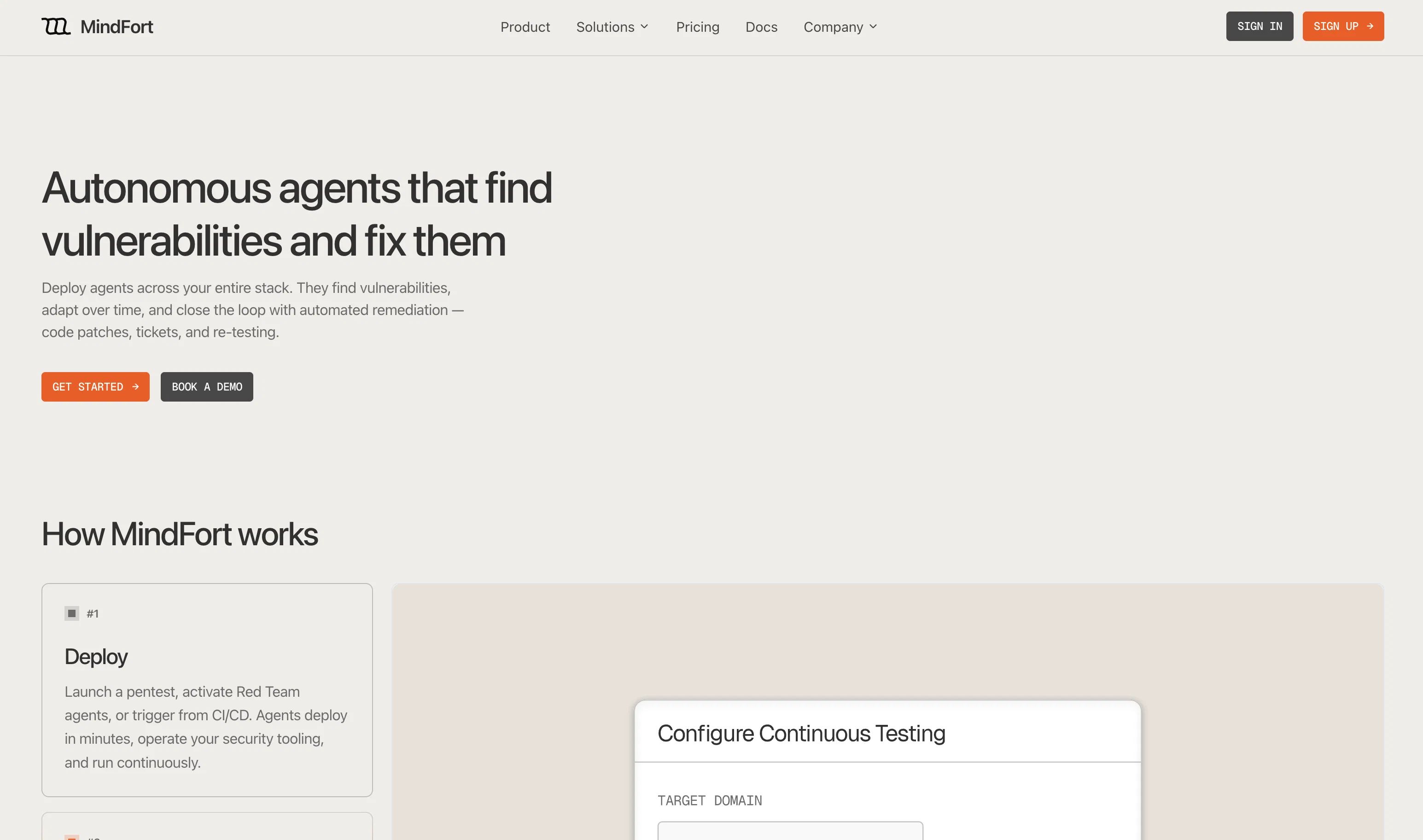
MindFort is an AI-powered platform intended for penetration testing, vulnerability exploit validation, and automated remediation. Its core products involve autonomous agents capable of identifying vulnerabilities across a users operations then automatically applying code patches, creating tickets for issues and re-testing to ensure they have been addressed.
MindFort's services include AI Pentests and AI Red Team. AI Pentests deliver a point-in-time assessment by mapping your attack surface, chaining exploits, and delivering compliant, exportable reports.
AI Red Team continuously probes your environment, adapts to new attack methods, remembers past attempts, and scales up for broader coverage. The system works by deploying agents which learn about your specific context and adapt over time to the environment.
Remediation involves patching code through tools like GitHub PRs, filing tickets in Jira and Linear with automatic re-testing, and amending cloud and infrastructure configurations.
This software also takes charge of patching misconfigured cloud infrastructure and making corrections to network-level configurations. MindForts Agentic Control System tracks changes made by agents, versioning, approval workflows and maintains a complete audit log for compliance.
The platform utilizes a mix of dynamic application security analysis, vulnerability management, software composition analysis, and threat intelligence.
MindFort's unique self-learning method means agents evolve based on your defenses, get sharper with every cycle and become more efficient at scale. The agents accumulate knowledge about organizational tech stack, configuration patterns, and security posture, thereby enhancing their testing and remediation effectiveness over time.
Help other people by letting them know if this AI was useful.
Add your own prompts and outputs to help others understand how to use this AI.
Screenshot gallery
Pros & Cons
Pros
+Autonomous vulnerability identification
+Automated code patches
+Automatic ticket creation
+Continuous vulnerability re-testing
+Attack surface mapping
+Exploit chaining
+Compliant exportable reports
+Adapts to new attack methods
+Remembers past attack attempts
+Scalable security coverage
+Context-specific learning
+GitHub PRs for patching
+Jira, Linear ticket integration
+Cloud infrastructure patching
+Network configuration corrections
+Agent-driven changes tracking
+Versioning of changes
+Approval workflows
+Compliance-friendly audit logs
+Combines dynamic application security analysis
+In-built vulnerability management
+Software composition analysis
+Real-time threat intelligence
+Self-learning security agents
+Knowledge accumulation about tech stack
+Adaptive testing efficiency
+Remediation effectiveness over time
+Persistent adversarial agents
+CI/CD triggering
+Assessment scheduling options
+Software, cloud, network remediations
+Direct cloud config remediation
+Network & infrastructure remediation
+Agent control with versioning
+Real-time threat data utilization
+Continuous asset discovery
+Environment-aware testing
+Adaptive attack strategies
+Efficient scaling
+Vulnerability research-based model
+Real-world attack data training
+Privacy-focused
+Continuous model improvement
Cons
−Needs specific system integrations
−Potential compliance issues
−Agentic control complexity
−Adapts slow to environment
−Dependent on continuous updates
−Heavily reliant on agents
−Lack of multi-language support
−Could overwhelm existing workflows
−Requires initial configuration
−Lack of real-time support
A Professional Framework to Evaluate MindFort
When considering MindFort for integration into your organizational workflow, we recommend deploying a structured score card across three critical operational pillars: Security & Compliance, Integration Friction, and long-term Price Scalability. Rather than looking only at basic feature lists, modern procurement teams must assess how a software platform behaves under high load and how well it fits into the team's data security guidelines.
1. Security and Database Compliance
Depending on your operating region and field, ensure that MindFort supports standard security layers such as SOC 2 Type II certifications, GDPR compliance, or HIPAA-compliant database encryption. If the tool connects directly to client database tables or handles user passwords, verify that they implement multi-factor authentication (MFA), single sign-on (SSO) integrations, and end-to-end data encryption in transit and at rest.
2. API Coverage and Custom Integrations
Siloed data is the primary cause of operational friction. Evaluate if MindFort has native connectors for your current project trackers, messaging hubs, and customer communication channels. For custom developer requirements, check if they provide a fully documented REST API with reasonable rate limits, comprehensive Webhooks support, and robust SDK packages in your language. A flexible API layer saves hundreds of hours of manual copy-paste overhead.
3. Total Cost of Ownership (TCO)
SaaS pricing packages are often deceptively simple. When reviewing MindFort's billing structure, map out your team's projected expansion over the next 12 to 24 months. Determine how costs scale as your customer database increases or as you add team members. Factor in setup costs, mandatory support plan upgrades, API access fees, and storage overage rates to understand the true cost before committing to a contract.
By combining verified user reviews from our directory with internal workflow pilot tests, your procurement team can make an informed decision that drives productivity without creating capital waste.
Features of MindFort
Agent
Automated Remediation
Vulnerability Detection
Adaptive Security
Autonomous Agents
Self Learning Agents
Free + From $199/Mo
SaaS1to10 verified reviews for MindFort
Overall rating
★★★★★5.0
Based on 4 reviews
★★★★★5.01 months ago
“Review”
Really impressed with @CodeThreat! It’s great to have a free tool that detects both code vulnerabilities and library risks. The setup was smooth, and it fits well into CI/CD pipelines. Definitely worth checking out!
Mark Reynolds
★★★★★5.01 months ago
“Review”
Best AI tool
דניאל
★★★★★5.02 months ago
“Review”
I have used AISAFE a lot for security research involving WordPress plugins and CVE-related submissions through the Wordfence program. Pros: + Great with mapping important parts of codebase and highlighting the areas worth looking into. + Reduces a lot of time spent searching trough bloat unrelated code. + Makes the whole manual testing part a lot easier. + Useful for pentesters, bug bounty hunters or any type of source-code audits. Cons: - Some leads might not be exploitable and manual trimming is still required. Overall AISAFE is a great skill MULTIPLIER for any pentester, it wont replace you but it will make you better at it.
Allon
★★★★★5.02 months ago
“Review”
ZeroThreat has been a true game-changer for our team. As someone who cares deeply about keeping our retail platform secure, I love how ZeroThreat quietly works behind the scenes, spotting and blocking threats before they become issues—without requiring constant monitoring or technical know-how. The alerts are simple to understand, actionable, and extremely reliable—no more chasing false alarms. Since integrating ZeroThreat, we've seen a noticeable drop in suspicious activity, and I wake up each day knowing our APIs are well-protected. It makes security effortless and gives our whole team peace of mind.