5.02 months ago
“Review”
We're looking to rollout major integrations for Google Search Console and Bing within the coming week. Contact us for more information on our roadmap!
New Odyssey

Observability for the AI era
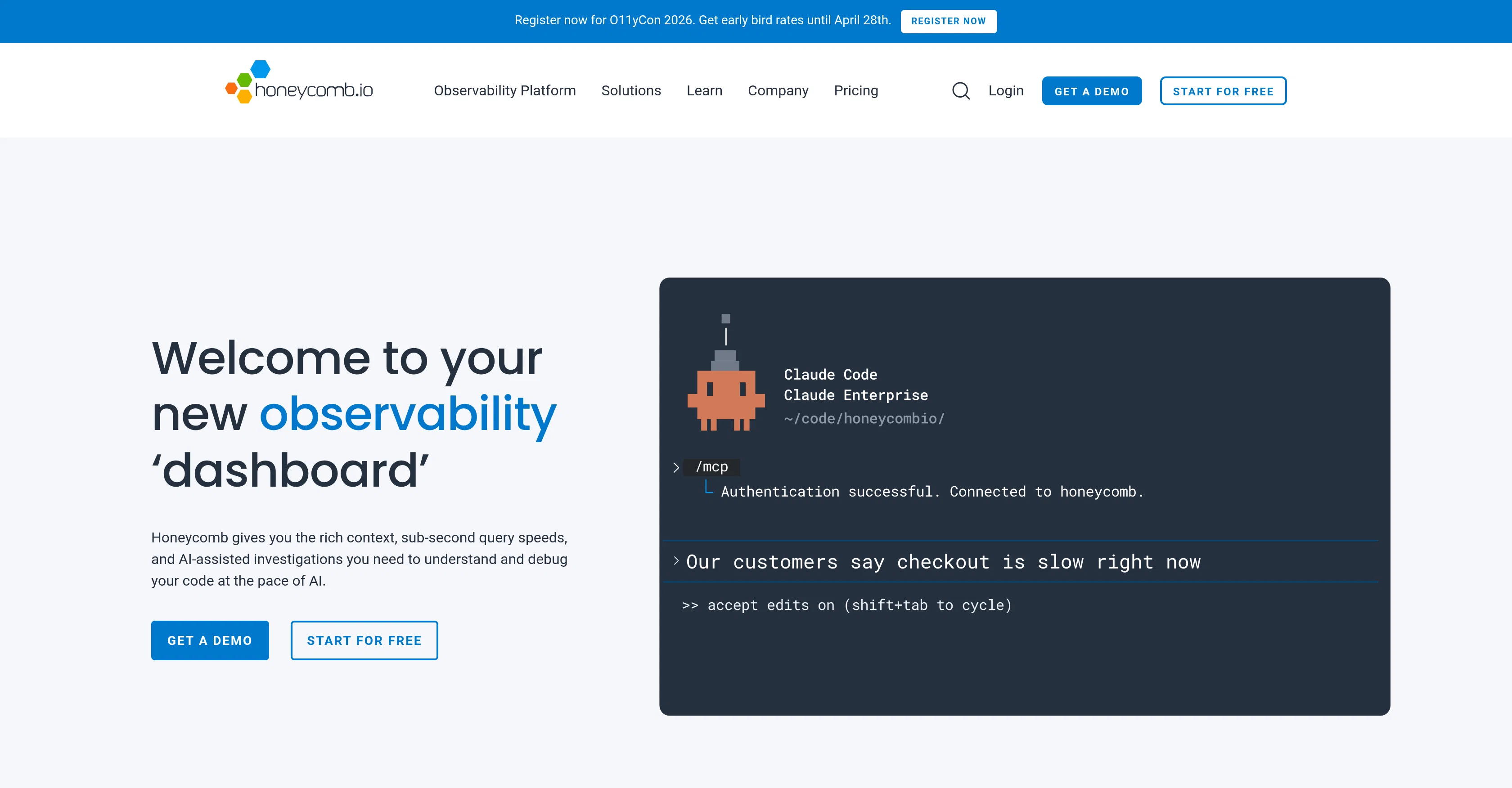
Honeycomb is an observability platform engineered for AI-driven software. Recognised for its swift query speed, unified telemetry, and Low Latency Microservices (LLM) observability, the platform sees use in companies such as Slack, Intercom, and Dropbox. The purpose-built, columnar data store at the heart of Honeycomb's platform allows for the tracing of distributed systems, debugging of LLM behavior, and swift transition from alert to answer to tackle complex engineering challenges. It integrates seamlessly into existing tech stacks, accommodating over 60 tools across the software development lifecycle. It offers AI-powered observability through Honeycomb Intelligence enriching every engineer with expert insights for instant investigations. Honeycomb's platform encourages investigations and insights by providing dynamic, explorable visualizations and incredibly fast results from their query engine. The Honeycomb platform also boasts AI agent integrations and OpenTelemetry compatibility. This comprehensive platform allows users to define strategies for telemetry data that control costs and yield quicker troubleshooting and deeper insights. Its scale is engineered to process the complex, voluminous telemetry of contemporary software systems. Observability data can be accessed directly with your AI agent Integrated Development Environment via Honeycomb MCP to maintain a streamlined investigative process. Furthermore, Honeycomb promotes Service Level Objective (SLO) based monitoring that assists in detecting and investigating anomalies in AI systems. Help other people by letting them know if this AI was useful. Add your own prompts and outputs to help others understand how to use this AI.
When considering Honeycomb for integration into your organizational workflow, we recommend deploying a structured score card across three critical operational pillars: Security & Compliance, Integration Friction, and long-term Price Scalability. Rather than looking only at basic feature lists, modern procurement teams must assess how a software platform behaves under high load and how well it fits into the team's data security guidelines.
Depending on your operating region and field, ensure that Honeycomb supports standard security layers such as SOC 2 Type II certifications, GDPR compliance, or HIPAA-compliant database encryption. If the tool connects directly to client database tables or handles user passwords, verify that they implement multi-factor authentication (MFA), single sign-on (SSO) integrations, and end-to-end data encryption in transit and at rest.
Siloed data is the primary cause of operational friction. Evaluate if Honeycomb has native connectors for your current project trackers, messaging hubs, and customer communication channels. For custom developer requirements, check if they provide a fully documented REST API with reasonable rate limits, comprehensive Webhooks support, and robust SDK packages in your language. A flexible API layer saves hundreds of hours of manual copy-paste overhead.
SaaS pricing packages are often deceptively simple. When reviewing Honeycomb's billing structure, map out your team's projected expansion over the next 12 to 24 months. Determine how costs scale as your customer database increases or as you add team members. Factor in setup costs, mandatory support plan upgrades, API access fees, and storage overage rates to understand the true cost before committing to a contract.
By combining verified user reviews from our directory with internal workflow pilot tests, your procurement team can make an informed decision that drives productivity without creating capital waste.
Overall rating
Based on 2 reviews
We're looking to rollout major integrations for Google Search Console and Bing within the coming week. Contact us for more information on our roadmap!
New Odyssey
We're LIVE :)
Ezzaky Ab.
Starting Price
Free plan available
Free tier available with optional paid upgrades.