5.02 months ago
“Review”
Best AI tool
דניאל

The most comprehensive AI security platform.
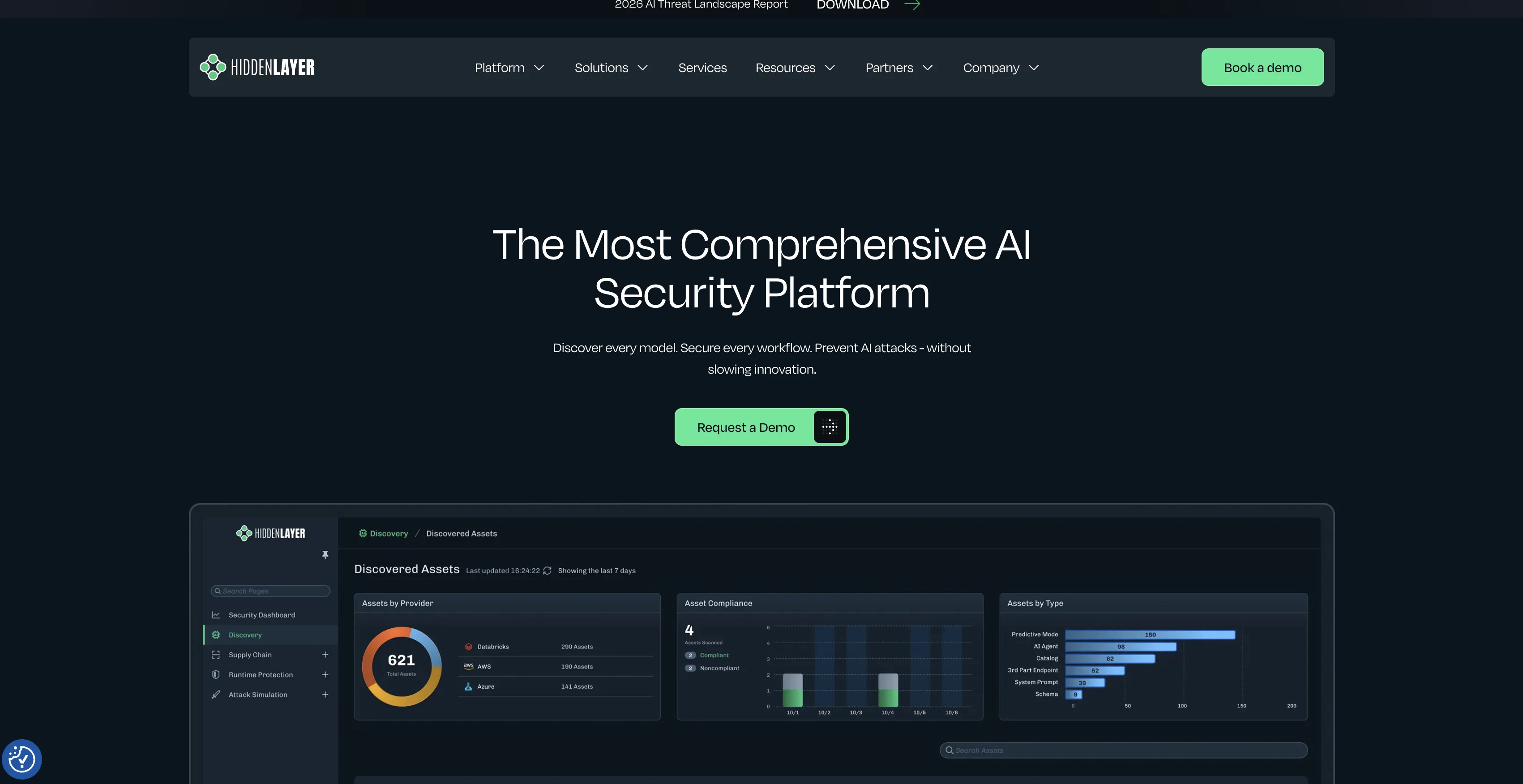
HiddenLayer is a comprehensive AI security platform designed to protect AI assets and mitigate potential threats at every stage of the AI lifecycle. The platform features AI Discovery, which offers visibility into AI assets across multiple environments to prevent shadow AI - untracked or unapproved AI deployments. It also includes AI Supply Chain Security to secure AI models before deployment by verifying their integrity and supply chain. Another feature, AI Runtime Security, is built to detect and respond to AI attacks without impacting production performance. Furthermore, the platform provides an AI Attack Simulation to continuously stress test AI systems with adversarial simulations, effectively identifying weaknesses before they can be exploited by attackers. The platform ensures secure AI rollouts, prompt attacks prevention, model extraction prohibition, and data leakage prevention. In addition, HiddenLayer offers a governance feature which aids in maintaining predictable, compliant, and policy-adherent AI across the enterprise. It integrates with existing security and MLOps stack, making it an inclusive tool for AI security. It is designed to be model-agnostic, agentless, and requires zero training data to deploy. Help other people by letting them know if this AI was useful. Add your own prompts and outputs to help others understand how to use this AI.
When considering HiddenLayer for integration into your organizational workflow, we recommend deploying a structured score card across three critical operational pillars: Security & Compliance, Integration Friction, and long-term Price Scalability. Rather than looking only at basic feature lists, modern procurement teams must assess how a software platform behaves under high load and how well it fits into the team's data security guidelines.
Depending on your operating region and field, ensure that HiddenLayer supports standard security layers such as SOC 2 Type II certifications, GDPR compliance, or HIPAA-compliant database encryption. If the tool connects directly to client database tables or handles user passwords, verify that they implement multi-factor authentication (MFA), single sign-on (SSO) integrations, and end-to-end data encryption in transit and at rest.
Siloed data is the primary cause of operational friction. Evaluate if HiddenLayer has native connectors for your current project trackers, messaging hubs, and customer communication channels. For custom developer requirements, check if they provide a fully documented REST API with reasonable rate limits, comprehensive Webhooks support, and robust SDK packages in your language. A flexible API layer saves hundreds of hours of manual copy-paste overhead.
SaaS pricing packages are often deceptively simple. When reviewing HiddenLayer's billing structure, map out your team's projected expansion over the next 12 to 24 months. Determine how costs scale as your customer database increases or as you add team members. Factor in setup costs, mandatory support plan upgrades, API access fees, and storage overage rates to understand the true cost before committing to a contract.
By combining verified user reviews from our directory with internal workflow pilot tests, your procurement team can make an informed decision that drives productivity without creating capital waste.
Overall rating
Based on 4 reviews
Best AI tool
דניאל
Not just alerts - real time visibility for Slack, Google Workspace, and AI APIs to stop risks before they become breaches
Zack Fediay
Best LLMops tool in the market.
Manouk Draisma
AI firewall for PII and smart routing looks promising.
ai arena
Starting Price
Contact vendor for pricing
Pricing may vary based on team size and features selected.