5.01 months ago
“Review”
2 times I tried and it threw error. it is not clear how to use it.
marcelo prizmic

Autonomous AI SRE for rapid alert diagnosis
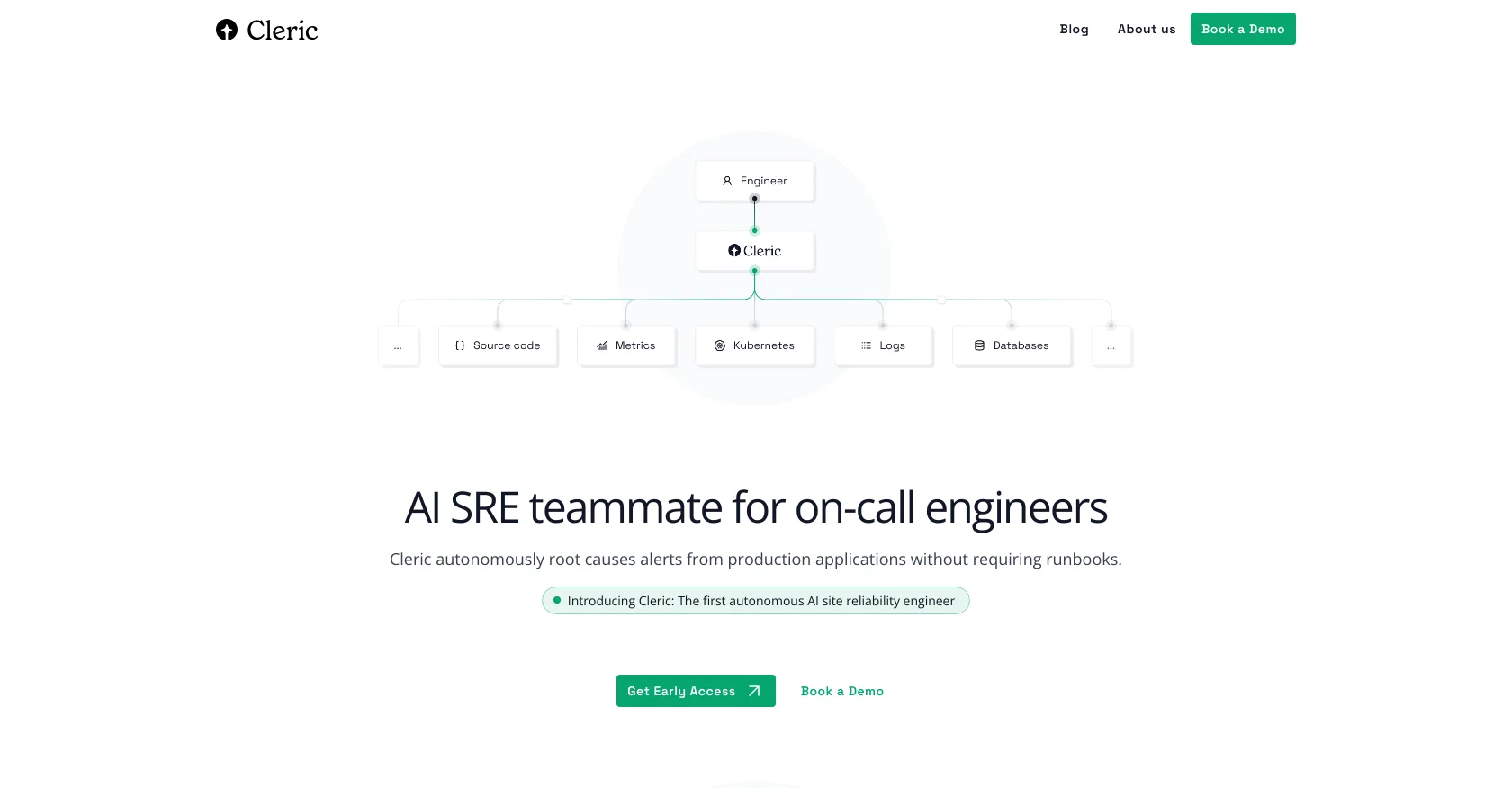
Cleric serves as an Artificial Intelligence Site Reliability Engineer (AI SRE) that aims to streamline the process of diagnosing production issues in complex cloud-native environments for engineering teams. It is designed to autonomously root cause alerts stemming from production applications, alleviating the need for human-operated runbooks. The main goal of Cleric is to provide a closed-loop infrastructure where AI operates crucial processes, reducing the stress on human operators who often struggle to scale and process large quantities of data. This results in reduced errors and enhanced efficiency. The tool is equipped to integrate with various platforms such as Github, Google Cloud, AWS, Kubernetes, Slack, Datadog, among others, establishing a broad spectrum of compatibility. Cleric trains on an extensive variety of production problems and adheres to industry best practices. Over time, it learns from the unique enterprise environment it operates within, thereby continuously improving its efficiency and effectiveness. Thus, Cleric stands as a capable AI teammate empowering on-call engineers by freeing them from time-consuming investigations and providing reliable triage and root cause analysis. Help other people by letting them know if this AI was useful. Add your own prompts and outputs to help others understand how to use this AI.
When considering Cleric for integration into your organizational workflow, we recommend deploying a structured score card across three critical operational pillars: Security & Compliance, Integration Friction, and long-term Price Scalability. Rather than looking only at basic feature lists, modern procurement teams must assess how a software platform behaves under high load and how well it fits into the team's data security guidelines.
Depending on your operating region and field, ensure that Cleric supports standard security layers such as SOC 2 Type II certifications, GDPR compliance, or HIPAA-compliant database encryption. If the tool connects directly to client database tables or handles user passwords, verify that they implement multi-factor authentication (MFA), single sign-on (SSO) integrations, and end-to-end data encryption in transit and at rest.
Siloed data is the primary cause of operational friction. Evaluate if Cleric has native connectors for your current project trackers, messaging hubs, and customer communication channels. For custom developer requirements, check if they provide a fully documented REST API with reasonable rate limits, comprehensive Webhooks support, and robust SDK packages in your language. A flexible API layer saves hundreds of hours of manual copy-paste overhead.
SaaS pricing packages are often deceptively simple. When reviewing Cleric's billing structure, map out your team's projected expansion over the next 12 to 24 months. Determine how costs scale as your customer database increases or as you add team members. Factor in setup costs, mandatory support plan upgrades, API access fees, and storage overage rates to understand the true cost before committing to a contract.
By combining verified user reviews from our directory with internal workflow pilot tests, your procurement team can make an informed decision that drives productivity without creating capital waste.
Overall rating
Based on 2 reviews
2 times I tried and it threw error. it is not clear how to use it.
marcelo prizmic
Best AI tool for SREs
Rakshita Vishakh
Starting Price
Contact vendor for pricing
Pricing may vary based on team size and features selected.