
Cascading
Unlock banking's potential with unified AI.
Cascading Overview
What is Cascading?
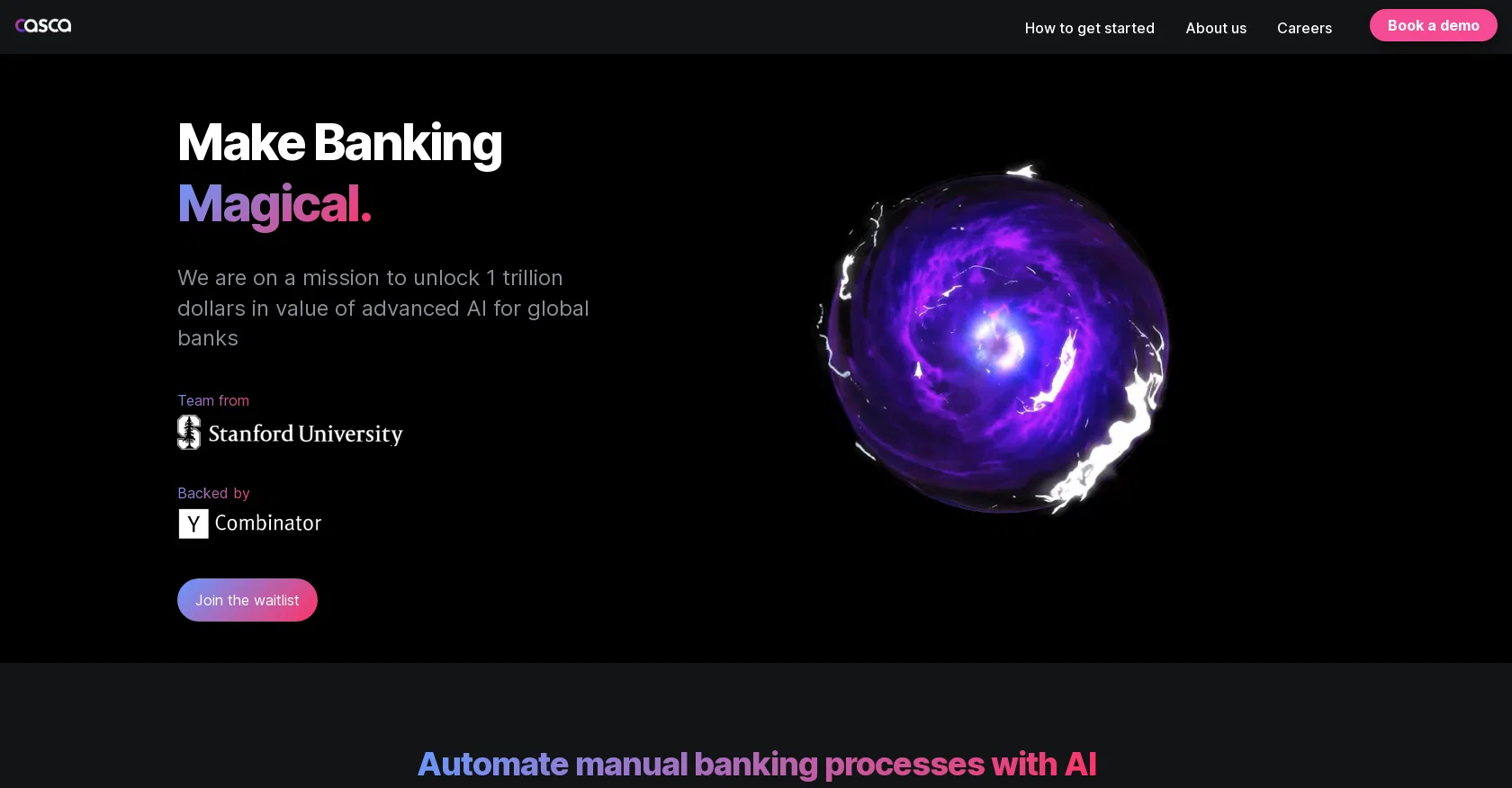
Cascading AI is a tool that aims to automate manual banking processes using advanced AI capabilities. Specifically, it offers a solution for document collection needed for loan applications, account opening, Know Your Customer (KYC)/Know Your Business (KYB) procedures, and more. The tool allows AI agents to communicate with customers through text, email, or phone calls, collecting necessary documents such as pay stubs, bank statements, tax returns, and certificates of good standing. It also facilitates document analysis and follows up with clients to resolve any discrepancies, potentially increasing conversion rates while saving time previously spent on manual customer communication.Additionally, Cascading AI provides customer service support by leveraging AI agents to cluster customer complaints, understand areas of concern, and generate responses based on bank policies and information stored in the bank's systems. This can lead to improved customer satisfaction through rapid responses and a decrease in customer support costs.Furthermore, the tool offers back-office automation capabilities for tasks like payments exception handling and securities settlement. Its AI agent can navigate core banking systems, gather information, and make recommendations. It can also analyze non-STP (Straight-Through Processing) exceptions that rules-based bots may struggle with. This can increase STP rates and reduce manual efforts in the back-office.Cascading AI works with leading core banking systems and technology providers, eliminating the need for building custom interfaces and infrastructure from scratch. The company has solid funding, strong connections to Silicon Valley, and brings top talent from Stanford University. It offers a waitlist for those interested in exploring the tool's potential for various AI use cases across different banking functions. Help other people by letting them know if this AI was useful. Add your own prompts and outputs to help others understand how to use this AI.
Screenshot gallery
Pros & Cons
Pros
- Automates banking operations
- Automated customer support
- Facilitates document collection
- Effective communication with clients
- Resolves document discrepancies
- Potentially increases conversion rates
- Saves time on customer communication
- Clusters customer complaints
- Generates response based on policies
- Improves customer satisfaction
- Reduces customer support costs
- Offers back-office automation
- Handles payments exception
- Handles securities settlement
- Navigates core banking systems
- Makes recommendations
- Handles non-STP exceptions
- Increases STP rates
- Reduces manual effort
- Compatible with leading banking systems
- Eliminates need for custom interfaces
- Strong connections to Silicon Valley
- Top talent from Stanford University
- Solid funding
- Offers comprehensive ML platform
- Single solution for data analysis
- Streamlines operations
- Maximizes results
- Can automate all banking functions
Cons
- No real-time support
- Limited to text, phone, and email communication
- Dependency on core banking systems
- Lacks customizability
- Relies on human-in-the-loop
- No specific cybersecurity measures mentioned
- No mention of handling multi-language support
- Dependent on quality of bank's data
- Waitlist required to use
- No stated support for third-party integrations
A Professional Framework to Evaluate Cascading
When considering Cascading for integration into your organizational workflow, we recommend deploying a structured score card across three critical operational pillars: Security & Compliance, Integration Friction, and long-term Price Scalability. Rather than looking only at basic feature lists, modern procurement teams must assess how a software platform behaves under high load and how well it fits into the team's data security guidelines.
1. Security and Database Compliance
Depending on your operating region and field, ensure that Cascading supports standard security layers such as SOC 2 Type II certifications, GDPR compliance, or HIPAA-compliant database encryption. If the tool connects directly to client database tables or handles user passwords, verify that they implement multi-factor authentication (MFA), single sign-on (SSO) integrations, and end-to-end data encryption in transit and at rest.
2. API Coverage and Custom Integrations
Siloed data is the primary cause of operational friction. Evaluate if Cascading has native connectors for your current project trackers, messaging hubs, and customer communication channels. For custom developer requirements, check if they provide a fully documented REST API with reasonable rate limits, comprehensive Webhooks support, and robust SDK packages in your language. A flexible API layer saves hundreds of hours of manual copy-paste overhead.
3. Total Cost of Ownership (TCO)
SaaS pricing packages are often deceptively simple. When reviewing Cascading's billing structure, map out your team's projected expansion over the next 12 to 24 months. Determine how costs scale as your customer database increases or as you add team members. Factor in setup costs, mandatory support plan upgrades, API access fees, and storage overage rates to understand the true cost before committing to a contract.
By combining verified user reviews from our directory with internal workflow pilot tests, your procurement team can make an informed decision that drives productivity without creating capital waste.
Features of Cascading
- Automation
- Banks
- Customer
- Document
- Process
- Processing
SaaS1to10 verified reviews for Cascading
Overall rating
Based on 15 reviews
No reviews yet. Be the first to write one.
Pricing
Starting Price
Contact vendor for pricing
Pricing may vary based on team size and features selected.
Where can Cascading be deployed?
- Cloud, SaaS, Web-Based