Boundary AI
Build production-ready AI apps with ease
Boundary AI Overview
What is Boundary AI?
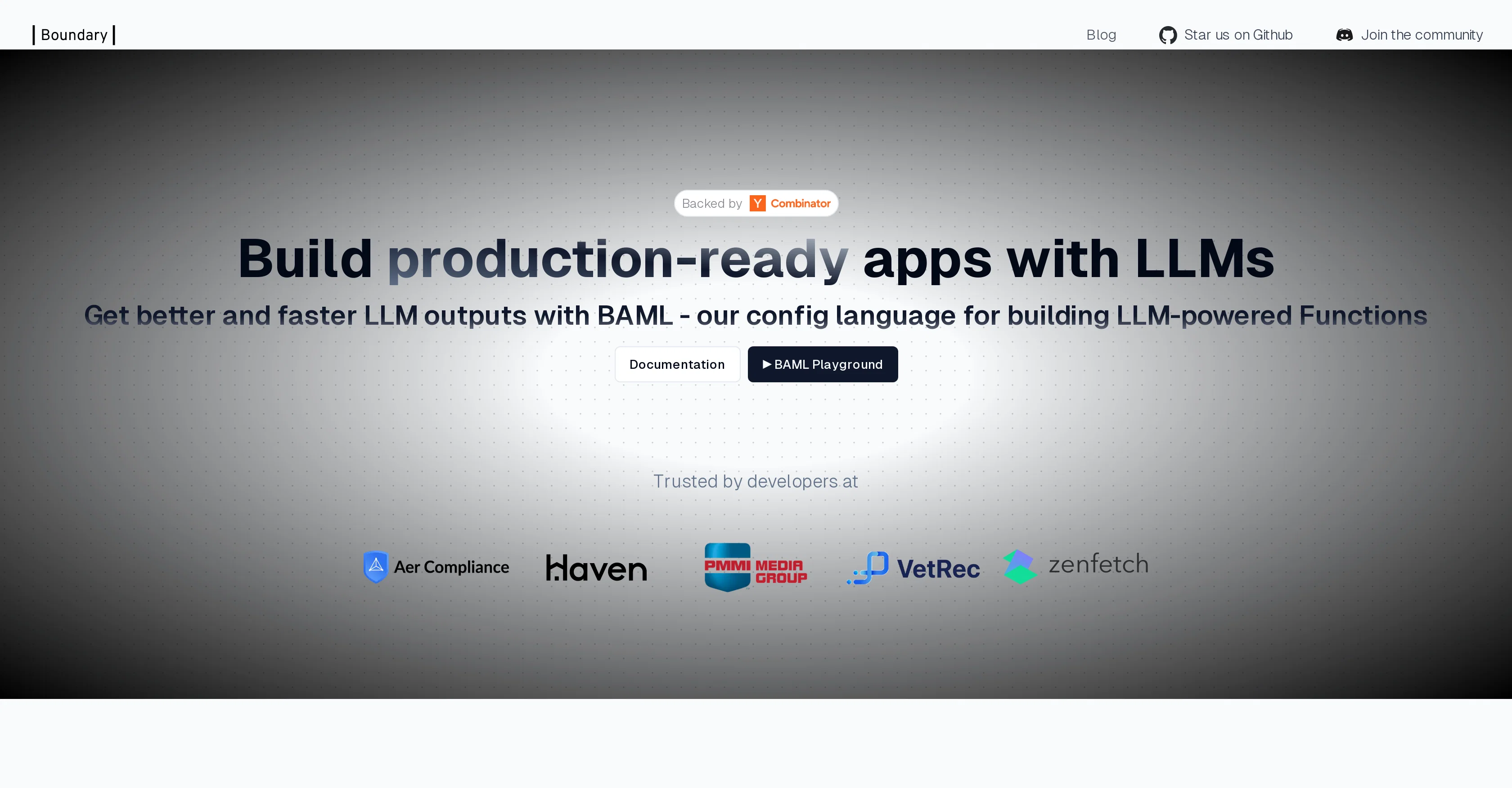
Boundary AI is a comprehensive toolkit aimed primarily at facilitating tasks for AI engineers. Through its special config language known as BAML (Basically, A Made-up Language), it enhances the performance of LLMs (Large Language Models). With BAML, AI engineers can turn complex prompt templates into typed functions that are not only easier to execute but also to test, eliminating parsing boilerplate and type errors. In a sense, employing an LLM with BAML resembles invoking a regular function. Boundary AI also supports instantaneous testing of new prompts in various IDEs, including BAML's VSCode Playground UI. Furthermore, the toolkit includes Boundary Studio, a feature for monitoring and tracking the performance of each LLM function over time. Importantly, BAML is primarily coded in Rust and supports Openai, Anthropic, Gemini, Mistral, and self-brought models with plans to include non-generative models. Deployment with BAML generates Python or Typescript code. Unlike other data modeling libraries, BAML is uniquely typesafe and never obscures prompts. It features an integrated playground and can support any model. The BAML compiler, as well as the VSCode extension for BAML, are free and open source, with paid services starting for those using the monitoring and improving functions of Boundary Studio. Help other people by letting them know if this AI was useful. Add your own prompts and outputs to help others understand how to use this AI.
Screenshot gallery
Pros & Cons
Pros
- Special config language BAML
- Enhances LLM performance
- Turns complex templates into functions
- Easier test execution
- Eliminates parsing boilerplate
- Reduces type errors
- Instantaneous testing of prompts
- Supports various IDEs
- Includes VSCode Playground UI
- Performance monitoring feature
- Supports multiple models
- Plans for non-generative models
- Generates Python or Typescript code
- Uniquely typesafe
- Never obscures prompts
- Integrated playground feature
- Supports any model
- Free BAML compiler
- Free VSCode extension
- Paid services for monitoring
- Improving functions available
- BAML coded in Rust
- Trusted by various developers
- Validated output schemas
- Rapid testing in IDE
- Boundary Studio for performance tracking
- Deployment does not install compiler
- BAML-generated code is secure
- Transparent pricing structure
- Can be easily evaluated
- Compared favorably to Pydantic
- Backed by Ycombinator
- Supported by former Amazon engineers
- Custom-built compiler
Cons
- Requires familiarity with BAML
- Reliance on specific IDEs
- Paid services for monitoring
- Doesn't support non-generative models yet
- Deployment limited to Python, TypeScript
- Primary codebase in Rust
- Requires manual activation for trace publishing
- No direct server communication
- Possible compatibility issues with other frameworks
A Professional Framework to Evaluate Boundary AI
When considering Boundary AI for integration into your organizational workflow, we recommend deploying a structured score card across three critical operational pillars: Security & Compliance, Integration Friction, and long-term Price Scalability. Rather than looking only at basic feature lists, modern procurement teams must assess how a software platform behaves under high load and how well it fits into the team's data security guidelines.
1. Security and Database Compliance
Depending on your operating region and field, ensure that Boundary AI supports standard security layers such as SOC 2 Type II certifications, GDPR compliance, or HIPAA-compliant database encryption. If the tool connects directly to client database tables or handles user passwords, verify that they implement multi-factor authentication (MFA), single sign-on (SSO) integrations, and end-to-end data encryption in transit and at rest.
2. API Coverage and Custom Integrations
Siloed data is the primary cause of operational friction. Evaluate if Boundary AI has native connectors for your current project trackers, messaging hubs, and customer communication channels. For custom developer requirements, check if they provide a fully documented REST API with reasonable rate limits, comprehensive Webhooks support, and robust SDK packages in your language. A flexible API layer saves hundreds of hours of manual copy-paste overhead.
3. Total Cost of Ownership (TCO)
SaaS pricing packages are often deceptively simple. When reviewing Boundary AI's billing structure, map out your team's projected expansion over the next 12 to 24 months. Determine how costs scale as your customer database increases or as you add team members. Factor in setup costs, mandatory support plan upgrades, API access fees, and storage overage rates to understand the true cost before committing to a contract.
By combining verified user reviews from our directory with internal workflow pilot tests, your procurement team can make an informed decision that drives productivity without creating capital waste.
Features of Boundary AI
- BAML
- AI Development
- Large Language Models
- AI Toolkit
- AI Engineering
- Config Language
- Free
SaaS1to10 verified reviews for Boundary AI
Overall rating
Based on 15 reviews
No reviews yet. Be the first to write one.
Pricing
Starting Price
Free plan available
Free tier available with optional paid upgrades.
Where can Boundary AI be deployed?
- Cloud, SaaS, Web-Based