Aikido Attack
AI pentests that simulate real attacks
Aikido Attack Overview
What is Aikido Attack?
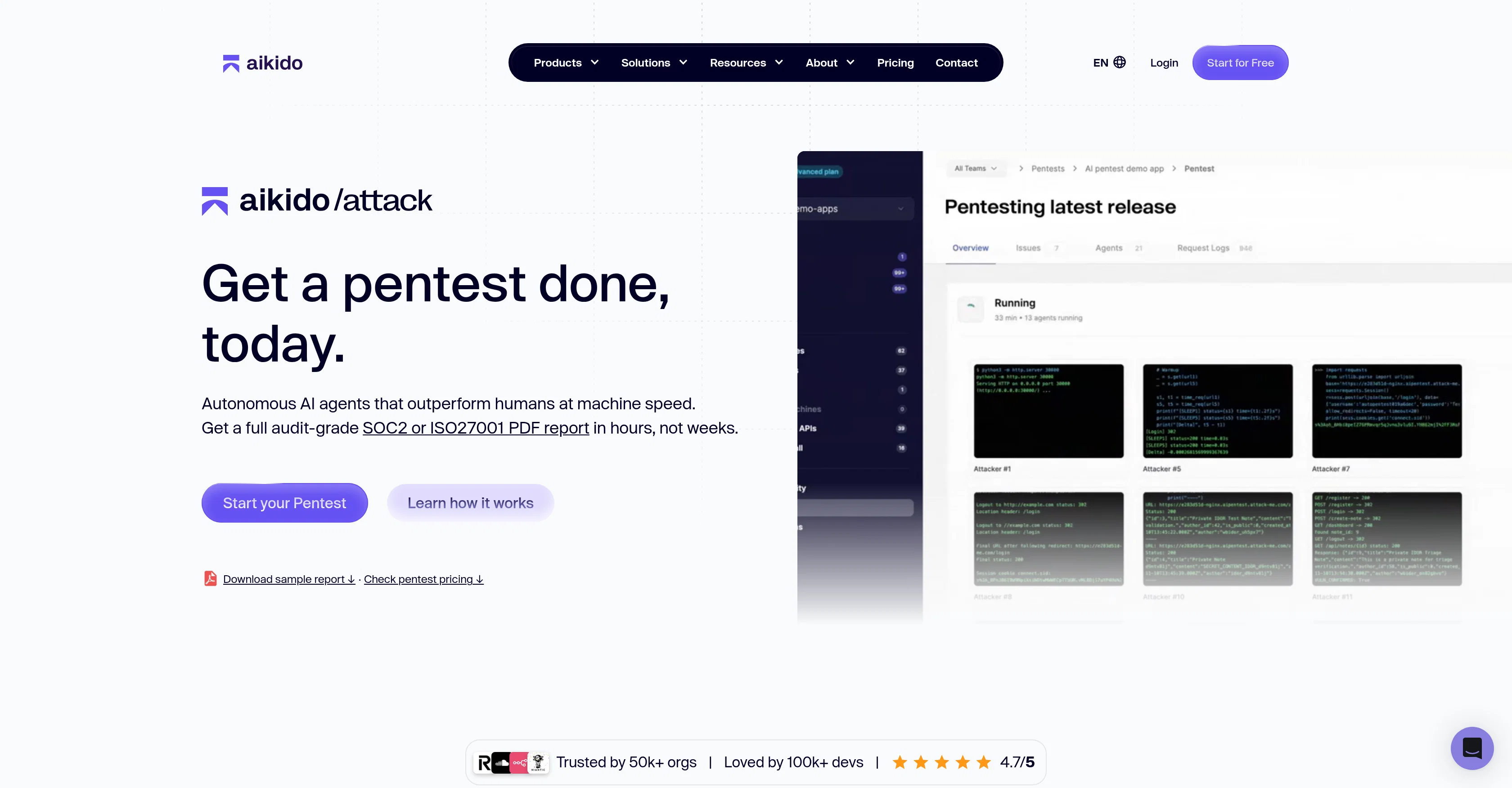
Aikido Security offers an AI-driven platform for cybersecurity purposes. It primarily focuses on AI-powered pentesting that simulates real attacks for a wide range of applications. These pentests are reported to outperform humans in their effectiveness and speed. Aikido's platform provides a suite of features for the complete lifecycle of software bill of materials (SBOM), from dependency management (SCA), SAST, AI SAST, IaC, code quality checks to malware scanning and license management. It also identifies outdated software and container image vulnerabilities. The tool is bolstered with cloud security that offers real-time visibility and controls for misconfigurations in virtual machines, Infrastructure as a Code (IaC), container and Kubernetes (K8s) scanning, as well as hardened images. The system offers continuous pentests and new pentest options, coupled with DAST attack surface management and API scanning. In-app runtime defense and threat detection capabilities are also included for added security measures. Comprehensive pentests can be initiated, monitored, and finalized within hours. The platform provides full visibility on request, exploit, and findings along with risk, root cause analysis, and reproduction steps. Auto remediation aids in resolving discovered issues, generating fixes to eliminate risk. Aikido's security solution is applicable across industries, including but not limited to FinTech, HealthTech, Legal Tech, agencies, mobile apps manufacturing, and public sector. Help other people by letting them know if this AI was useful. Add your own prompts and outputs to help others understand how to use this AI.
Screenshot gallery
Pros & Cons
Pros
- Wide range of applications
- Outperforms humans in effectiveness
- Fast pentesting
- Complete lifecycle of SBOM
- Dependency management
- IaC support
- Code quality checks
- Malware scanning functionality
- License management functionality
- Identifies outdated software
- Container image vulnerability detection
- Cloud security features
- Real-time visibility in cloud
- Detection of misconfigurations
- Virtual machine scanning
- Kubernetes scanning
- Provides hardened images
- Continuous Pentesting
- DAST Attack Surface Management
- API Scanning
- In-app runtime defense
- Threat detection capabilities
- Quickly initiated comprehensive pentests
- Full visibility of pentesting
- Exploit findings and risks
- Root cause analysis
- Automated remediation
- Cross industry applicability
- AutoFix feature
- IDE integrations
- On-Prem scanning
- Supply Chain Safety
- Compliance Vulnerability Management
- Generate SBOMs
- Block 0-Days feature
- Supports multiple industries
- Complete security HQ
- Container and K8s Scanning
- Runtime Protection
- False-positive and Hallucination prevention
- Audit-Ready Report
- Multiple testing approaches
- Automated penetration testing
- Agent behavior analysis
- Full Visibility & Attack Analysis
- Built-in remediation
- Live monitoring of pentest
- Zero Findings = Zero Cost
Cons
- No mobile app
- No multi-language support
- Bias towards pentesting
- No explicit data encryption
- Not suitable for small-scope apps
- Limited roles for testing
- No microservices support under basic plan
- No SDKs available
A Professional Framework to Evaluate Aikido Attack
When considering Aikido Attack for integration into your organizational workflow, we recommend deploying a structured score card across three critical operational pillars: Security & Compliance, Integration Friction, and long-term Price Scalability. Rather than looking only at basic feature lists, modern procurement teams must assess how a software platform behaves under high load and how well it fits into the team's data security guidelines.
1. Security and Database Compliance
Depending on your operating region and field, ensure that Aikido Attack supports standard security layers such as SOC 2 Type II certifications, GDPR compliance, or HIPAA-compliant database encryption. If the tool connects directly to client database tables or handles user passwords, verify that they implement multi-factor authentication (MFA), single sign-on (SSO) integrations, and end-to-end data encryption in transit and at rest.
2. API Coverage and Custom Integrations
Siloed data is the primary cause of operational friction. Evaluate if Aikido Attack has native connectors for your current project trackers, messaging hubs, and customer communication channels. For custom developer requirements, check if they provide a fully documented REST API with reasonable rate limits, comprehensive Webhooks support, and robust SDK packages in your language. A flexible API layer saves hundreds of hours of manual copy-paste overhead.
3. Total Cost of Ownership (TCO)
SaaS pricing packages are often deceptively simple. When reviewing Aikido Attack's billing structure, map out your team's projected expansion over the next 12 to 24 months. Determine how costs scale as your customer database increases or as you add team members. Factor in setup costs, mandatory support plan upgrades, API access fees, and storage overage rates to understand the true cost before committing to a contract.
By combining verified user reviews from our directory with internal workflow pilot tests, your procurement team can make an informed decision that drives productivity without creating capital waste.
Features of Aikido Attack
- Agent
- AI Pentesting
- Cybersecurity
- Real Attack Simulation
- Continuous Pentesting
- Software Security
- From $945
SaaS1to10 verified reviews for Aikido Attack
Overall rating
Based on 14 reviews
No reviews yet. Be the first to write one.
Pricing
Starting Price
From $18.00/user/month
Pricing may vary based on team size and features selected.
Where can Aikido Attack be deployed?
- Cloud, SaaS, Web-Based