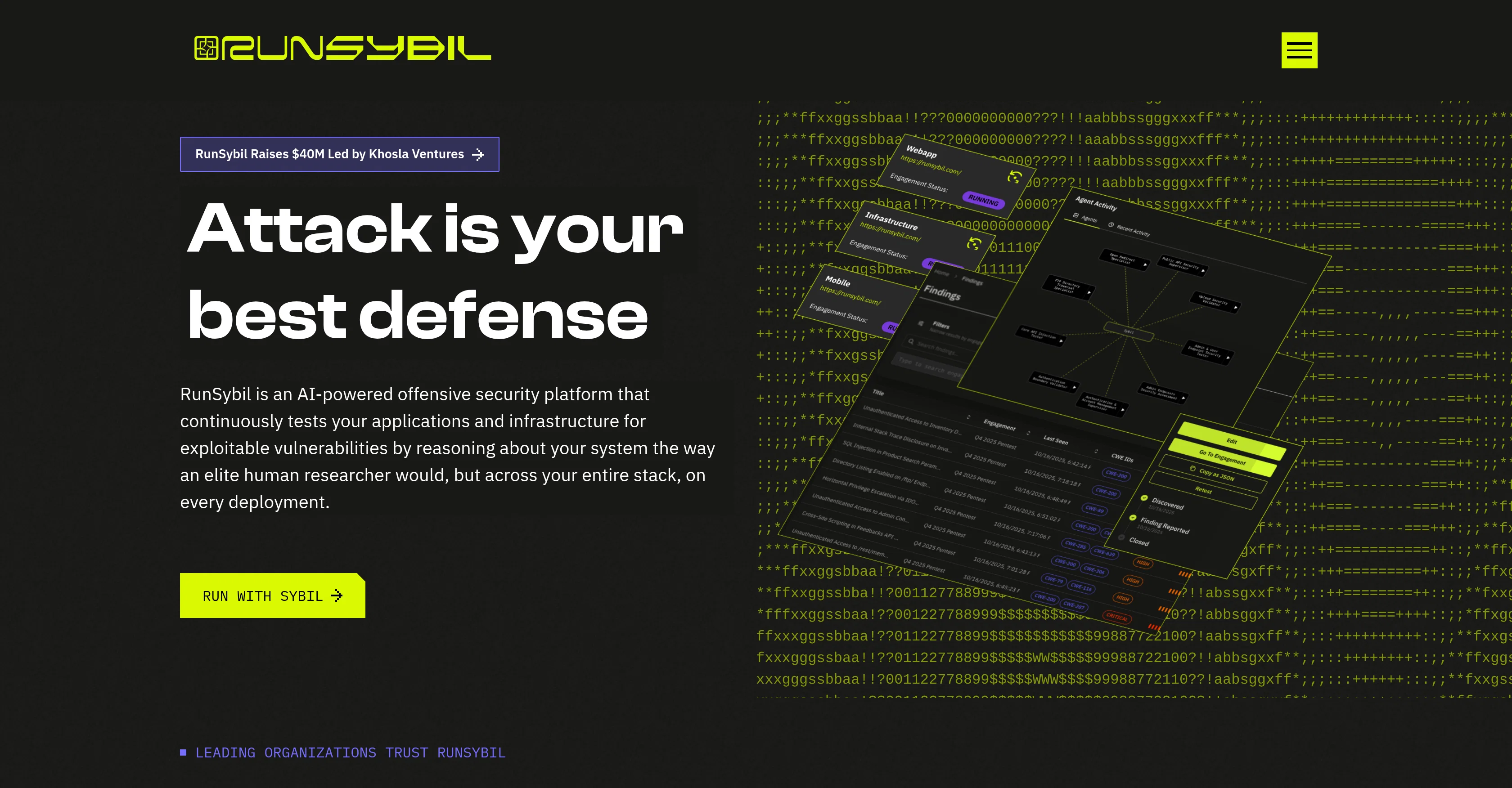
RunSybil is an AI-powered offensive security platform designed to continuously scan the applications and infrastructure of an organization for potential vulnerabilities.
Using a method similar to how an experienced researcher would approach a system, it spans your software stack and analyzes every deployment to identify exposures.
It's particularly effective in pinpointing vulnerabilities where different components connect, a detail often overlooked by other scanners. RunSybil operates on a proactive basis, re-evaluating your security posture in real-time to suit your system's current conditions.
It also provides security feedback on every pull request, spotting vulnerabilities early rather than after a breach. Unlike traditional scanning setups that often look for known signatures, RunSybil thinks like an actual attacker, chaining vulnerabilities across your system to uncover genuine, exploitable paths.
Five main uses of RunSybil include continuous attack surface monitoring, multi-tenant and business logic testing, bug bounty and pentesting, cloud and infrastructure security validation, and enabling CTEM programs.
It builds a model of your application and infrastructure, updates it regularly, and evaluates the changes to your specific attack surface to disclose only new or relatively exploitable risks.
In terms of cloud security, it identifies how an application vulnerability turns into the starting point for a full infrastructure compromise. RunSybil provides continuous offensive testing, transforming your CTEM program from a simple framework to an operational reality.
Help other people by letting them know if this AI was useful.
Add your own prompts and outputs to help others understand how to use this AI.
Screenshot gallery
Pros & Cons
Pros
+Continuous offense testing
+Proactive security posture adjustment
+Security feedback on PRs
+Thinks like an attacker
+Multilayer vulnerability chaining
+Cloud and infrastructure security
+Real-time applications and infrastructure scanning
−Constant real-time scanning may affect performance
−No mentioned support for legacy systems
−No explicit data privacy measures
−Not clear on remediation insights for issues
−No multi-language support mentioned
−No customization options stated
−Lack of integrations with other security tools
−No emergency support or SLA mentioned
−Potential for false positives not addressed
−No mention of handling encrypted data
A Professional Framework to Evaluate RunSybil
When considering RunSybil for integration into your organizational workflow, we recommend deploying a structured score card across three critical operational pillars: Security & Compliance, Integration Friction, and long-term Price Scalability. Rather than looking only at basic feature lists, modern procurement teams must assess how a software platform behaves under high load and how well it fits into the team's data security guidelines.
1. Security and Database Compliance
Depending on your operating region and field, ensure that RunSybil supports standard security layers such as SOC 2 Type II certifications, GDPR compliance, or HIPAA-compliant database encryption. If the tool connects directly to client database tables or handles user passwords, verify that they implement multi-factor authentication (MFA), single sign-on (SSO) integrations, and end-to-end data encryption in transit and at rest.
2. API Coverage and Custom Integrations
Siloed data is the primary cause of operational friction. Evaluate if RunSybil has native connectors for your current project trackers, messaging hubs, and customer communication channels. For custom developer requirements, check if they provide a fully documented REST API with reasonable rate limits, comprehensive Webhooks support, and robust SDK packages in your language. A flexible API layer saves hundreds of hours of manual copy-paste overhead.
3. Total Cost of Ownership (TCO)
SaaS pricing packages are often deceptively simple. When reviewing RunSybil's billing structure, map out your team's projected expansion over the next 12 to 24 months. Determine how costs scale as your customer database increases or as you add team members. Factor in setup costs, mandatory support plan upgrades, API access fees, and storage overage rates to understand the true cost before committing to a contract.
By combining verified user reviews from our directory with internal workflow pilot tests, your procurement team can make an informed decision that drives productivity without creating capital waste.
Features of RunSybil
Offensive Security
Pentesting
Vulnerability Scanning
Attack Surface Evaluation
Exploit Detection
Continuous Monitoring
SaaS1to10 verified reviews for RunSybil
Overall rating
★★★★★5.0
Based on 4 reviews
★★★★★5.02 months ago
“Review”
Really impressed with @CodeThreat! It’s great to have a free tool that detects both code vulnerabilities and library risks. The setup was smooth, and it fits well into CI/CD pipelines. Definitely worth checking out!
Mark Reynolds
★★★★★5.02 months ago
“Review”
Best AI tool
דניאל
★★★★★5.02 months ago
“Review”
I have used AISAFE a lot for security research involving WordPress plugins and CVE-related submissions through the Wordfence program. Pros: + Great with mapping important parts of codebase and highlighting the areas worth looking into. + Reduces a lot of time spent searching trough bloat unrelated code. + Makes the whole manual testing part a lot easier. + Useful for pentesters, bug bounty hunters or any type of source-code audits. Cons: - Some leads might not be exploitable and manual trimming is still required. Overall AISAFE is a great skill MULTIPLIER for any pentester, it wont replace you but it will make you better at it.
Allon
★★★★★5.02 months ago
“Review”
ZeroThreat has been a true game-changer for our team. As someone who cares deeply about keeping our retail platform secure, I love how ZeroThreat quietly works behind the scenes, spotting and blocking threats before they become issues—without requiring constant monitoring or technical know-how. The alerts are simple to understand, actionable, and extremely reliable—no more chasing false alarms. Since integrating ZeroThreat, we've seen a noticeable drop in suspicious activity, and I wake up each day knowing our APIs are well-protected. It makes security effortless and gives our whole team peace of mind.
Rachel Parker
Pricing
Starting Price
Contact vendor for pricing
Pricing may vary based on team size and features selected.